
The 19th century did not merely build better clocks.
It changed what time meant.
Before the railway, time was local. Noon was when the sun stood highest over your town. One city’s noon could differ from another’s by several minutes, and for most of human life, that was acceptable. The body moved by daylight. The village moved by church bells. The household moved by habit.
Then came the train.
A train cannot run on “roughly noon.” A factory cannot coordinate shifts by the sun over each neighborhood. A telegraph office cannot send schedules if every station believes in its own private hour.
The Victorian age took time, standardized it, distributed it, sold it, wore it, displayed it, measured it, moralized it – and never quite recovered.
That is why Steampunk returns to clocks so obsessively. The clock is not only decoration. It is the symbol of a civilization that decided precision was a virtue.
The 19th Century Invented “Being On Time” – And Never Recovered
Before standardized time, the world was looser.
A town clock mattered, but it mostly governed local life. The sun still held authority. If you lived and worked within walking distance, local time was enough.
The railroad broke that arrangement.
By the mid-19th century, trains were moving people across regions faster than local time could comfortably handle. A timetable only works if everyone agrees what the printed hour means. That forced societies to accept something new: time as a shared infrastructure.
In Britain, Greenwich Mean Time became increasingly important for railway coordination, and by the late Victorian period, standardized time had become part of ordinary life. What began as a technical solution became a social rule.
Being late stopped being vague.
It became measurable.
That shift matters. Once time can be measured precisely, punctuality becomes moralized. A person who keeps time appears disciplined, respectable, modern. A person who loses time appears careless.
The clock became more than a tool.
It became a character witness.
In a Steampunk interior, this history still hums behind every mantel clock, gear clock, pocket watch, and chronometer-style object. You are not simply placing a clock on a shelf. You are invoking the century that turned time into an ethical substance.
The Technologies of Victorian Time Measurement
The Telegraph and Time Distribution
The telegraph did for time what the railway did for distance.
It allowed a central reference time to be distributed across wide areas almost instantly. This was crucial for railroads, observatories, ports, financial institutions, and eventually public life.
In the United States, the Naval Observatory became part of the time-distribution story, sending precise time signals through telegraph networks. In ports, time balls served a similar function visually: a large sphere dropped at a fixed hour so ships could synchronize their marine chronometers.
The Greenwich time ball remains one of the most poetic machines of the age: a public signal that turns invisible precision into visible ritual.
A ball drops.
Ships set their clocks.
Navigation becomes safer.
That is pure Steampunk logic: a mechanical public gesture carrying scientific authority.
This infrastructure of synchronized time became the nervous system of industrial civilization. Railways, ships, factories, offices, and markets all depended on it. The modern world began to pulse in coordinated intervals.
For the instrument that made ocean navigation possible, see the complete history of the chronometer – precision timekeeping’s defining achievement.
The Pocket Watch – Democratization of Personal Time
The pocket watch made punctuality portable.
At the start of the 19th century, a good pocket watch was a luxury object. It belonged to the wealthy, the officer, the professional, the person who could afford precision in a private case.
Then factory production changed the market.
By the late 19th century, companies such as Waltham and Elgin helped make watches more accessible. The object moved from elite possession toward middle-class necessity. Railroad workers, factory managers, clerks, merchants, and professionals could carry time on the body.
That changed behavior.
A man with a pocket watch did not merely know the hour. He demonstrated that he lived by time. He could catch the train, arrive at the office, open the shop, coordinate the meeting, and prove that his day belonged to order.
The pocket watch became jewelry, yes.
But first, it was discipline.
Its chain across the waistcoat was not only decorative. It was a visible declaration: I am synchronized with the modern world.
For movement types and the technology this history built, see mechanical clock movements – the Victorian technology this history built.

The Zoetrope – Measuring Time’s Effect on Motion
The zoetrope seems, at first, to belong to entertainment rather than timekeeping.
But it belongs here.
Invented in the 1830s, the zoetrope used a spinning cylinder with slits and sequential images inside. When spun, the images appeared to move. A horse ran. A figure danced. A bird flapped its wings. Still images became motion through rhythm, speed, and perception.
The zoetrope did not measure time like a clock.
It made time visible.
That is a profound difference.
It showed that movement could be broken into intervals. It taught the eye that animation is sequence. It turned time from something abstract into something you could hold, spin, and watch.
This is deeply connected to the Steampunk imagination. Steampunk loves devices that reveal process: gears turning, pistons moving, lamps glowing, needles responding, wheels spinning. The zoetrope belongs to that family because it exposes the trick. It says: motion is not magic. Motion is timing.
In a modern collector’s room, a zoetrope or persistence-of-vision device sits naturally beside clocks, optical instruments, brass scientific tools, and mechanical toys. It is time performing in circles.
The Chronograph – Measuring Intervals
A normal clock tells you what time it is.
A chronograph tells you how much time has passed.
That difference is enormous.
The chronograph made intervals measurable: races, factory processes, military movements, experiments, mechanical tests, and athletic performance. It turned duration into data.
To a Victorian engineer, this mattered.
If you can measure an interval, you can compare it.
If you can compare it, you can improve it.
If you can improve it, you can industrialize it.
The stopwatch is one of the most underrated Steampunk objects for this reason. A brass case, crown button, small subdial, crisp hand movement – it contains the entire industrial attitude in the palm.
Not “what time is it?”
But “how long did it take?”
That is the question of factories, laboratories, railways, races, artillery, workshops, and modernity itself.
The chronograph is time sharpened into an instrument.
The Victorian Collector – Clocks as Status Objects
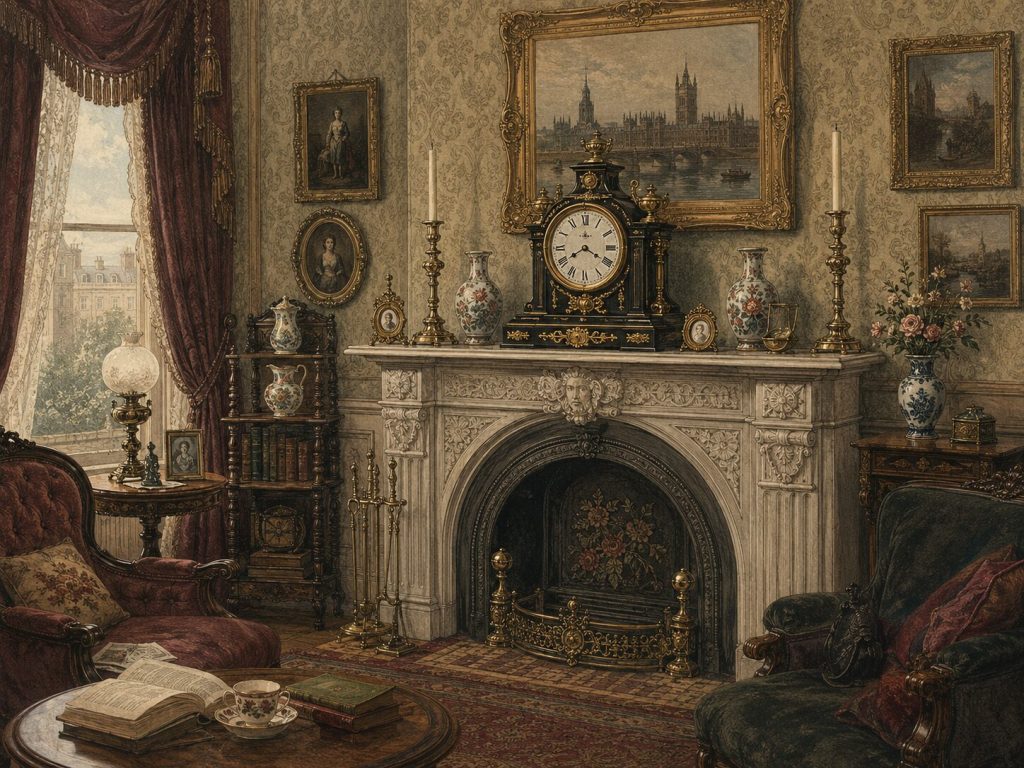
The Mantel Clock as Social Statement
The Victorian mantel clock was not placed casually.
It stood at the center of the parlor, usually on the mantelpiece – the most formal display surface in the room. Around it might sit candlesticks, vases, framed portraits, small sculptures, or instruments. But the clock held authority.
It was often the highest object.
The most symmetrical object.
The formal center.
A quality mantel clock said several things at once: the household had taste, money, discipline, and respect for time. It also said the room had a center.
Different clocks carried different social meanings.
A French marble mantel clock suggested wealth and refinement.
A Vienna regulator suggested horological seriousness.
A black slate mantel clock suggested middle-class aspiration.
A smaller mass-produced clock suggested entry into the culture of punctuality.
The message was never only “we know the time.”
The message was: we honor time.
That tradition still matters in Steampunk display. When you place a clock at the center of a shelf, mantel, or gallery wall, you are continuing a Victorian habit. The clock becomes the formal anchor around which other objects arrange themselves.
For modern composition principles, see placing your clock at the center of a steampunk wall composition.
The Cabinet of Horological Curiosities
Some Victorian collectors went further.
One clock was not enough.
They collected multiple clocks: pocket watches, regulators, travel clocks, carriage clocks, mantel clocks, marine chronometers, scientific timers, and novelty mechanisms. This was not because the household needed ten time sources. It was because each clock represented a different solution to the problem of measuring time.
The serious collector was not merely asking, “What hour is it?”
He was asking, “How does this machine know?”
That is the collector’s question.
A horological cabinet resembles a naturalist’s specimen cabinet. Each object is an example of a type: a regulator, a chronometer, a repeater, a stopwatch, a pocket watch, a mantel clock, a skeleton movement. Together they form a taxonomy of time.
This is where Steampunk collecting becomes more than theme decoration.
A shallow Steampunk room repeats gear motifs.
A serious one asks what the gears are for.
Modern Steampunk and the Inheritance of Time
A modern Steampunk clock collection is not simply nostalgia.
It is an affirmation of Victorian values – or at least a chosen version of them.
Precision matters.
Mechanisms are beautiful.
Time deserves visible form.
Measurement belongs in the home.
A room should reveal the mind of its owner.
That is why clocks work so powerfully in Steampunk interiors. They carry symbolic weight without needing explanation. A wall clock suggests order. A gear clock suggests mechanism. A Nixie-style clock suggests retro-technology. A chronometer-style box clock suggests navigation. A pocket watch suggests personal discipline. A mantel clock suggests parlor authority.
Together, they build atmosphere through meaning, not clutter.
For modern options that claim these values in different ways, see our top steampunk clocks – how to claim these values for your own space.
The guiding question is simple:
What would a Victorian engineer put on this wall?
Not what would look “vintage.”
Not what has the most gears.
Not what matches a Pinterest board.
What would belong to a person who measured, repaired, navigated, recorded, calculated, and cared about the visible structure of time?
That question will lead you to better objects.
Why Time Became Moral
The strangest thing about Victorian time culture is not that clocks became more accurate.
It is that people began to treat accuracy as character.
A missed train was not merely inconvenience. It was failure. Late arrival at work suggested poor discipline. A well-kept watch implied reliability. A synchronized office implied competence. A factory bell did not only announce time. It commanded bodies.
This is the darker edge of the story.
The same civilization that made beautiful clocks also made time oppressive. The factory whistle cut the day into labor units. The railway timetable punished slowness. The office clock measured productivity. The school bell trained children to move by schedule.
Steampunk often romanticizes the machinery.
But the machinery had teeth.
That tension is part of why the aesthetic remains powerful. A gear clock can feel beautiful and slightly severe. A regulator can feel elegant and disciplinary. A chronograph can feel scientific and ruthless.
The clock is not innocent.
It never was.
The Collector’s Lesson
A Steampunk collector should not treat clocks as filler objects.
A clock should either command the room, explain the room, or deepen the room’s philosophy.
A large wall clock can be the anchor.
A pocket watch can be the intimate detail.
A chronograph can sit beside engineering drawings.
A mantel clock can formalize a shelf.
A Nixie-style clock can introduce retro-technical glow.
A chronometer-style object can pull the whole room toward navigation, sea travel, and precision.
Each type carries a different part of the Victorian obsession.
Choose deliberately.
If your room already has barometers, thermometers, hygrometers, maps, sconces, and industrial shelves, the clock should not be random. It should complete the argument.
A clock is never neutral.
It tells time, yes.
But it also tells the room what kind of time it believes in.
Final Thought: The Room That Keeps Time
The 19th century did not invent time.
It invented the feeling that time could own us.
It gave us synchronized stations, telegraph signals, pocket watches, chronographs, factory bells, mantel clocks, time balls, railway timetables, and mechanical displays that turned invisible duration into public order.
Steampunk inherits all of it: the beauty, the discipline, the anxiety, the romance.
That is why the clock remains central.
Not because gears look cool.
Because the gear is the visible tooth of a much larger idea.
A serious Steampunk room does not merely decorate with clocks. It stages a relationship with time: measured, displayed, respected, questioned.
And somewhere on the wall or shelf, a dial waits.
For the full room built around this history, see the complete steampunk collector’s workshop – a room worthy of this history.


