
A barometer is one of the few objects that can sit on a wall and make the room feel smarter.
Not because it is decorative.
Because it is working.
A clock measures time. A thermometer measures heat. A hygrometer measures moisture. But a barometer measures something stranger: the weight of the sky pressing down on the room. It turns invisible atmospheric pressure into a needle’s small, deliberate movement.
That is why Steampunk collectors love it.
The aneroid barometer belongs naturally beside brass clocks, marine instruments, pipe shelving, old maps, and leather-bound field journals. It is scientific without feeling sterile. Mechanical without being loud. Beautiful without becoming useless.
In a Steampunk collector’s workshop, it does what the best objects always do:
It looks magnificent, and it still has a job.
For more collector instruments that belong in the same visual world, see our complete steampunk clocks and instruments guide – adding a barometer to your collection.
The Barometer as Steampunk Object – Science Wearing Its Work on Its Face
The Victorians did not hide measuring instruments in drawers.
They mounted them.
A barometer, thermometer, or hygrometer was not just a utility object. It was part of domestic intelligence. A middle-class Victorian home could display a small weather station the way another home might display porcelain, botanical specimens, or a clock under glass.
The instrument said something about the owner.
This was a household that noticed weather.
A household that measured.
A household that believed the world could be read if one owned the proper dial.
That is the Steampunk appeal.
A barometer has everything the style respects: brass, glass, needle, scale, calibrated markings, and a mechanism that translates natural force into visible information. It does not imitate science. It participates in it.
The dial is not decoration.
It is the face of pressure.
How an Aneroid Barometer Works
The Aneroid Capsule – No Mercury Required
The word aneroid means “without liquid.”
Older mercury barometers used a column of mercury to measure atmospheric pressure. They were accurate, beautiful, and inconvenient. Mercury is heavy, toxic, and not something most modern collectors want casually mounted in a home.
An aneroid barometer solves the problem mechanically.
Inside the case is a small sealed corrugated metal capsule, often made from a springy alloy such as beryllium copper or similar flexible metal. Most of the air is removed from the capsule. When outside air pressure rises, the capsule compresses slightly. When pressure falls, it expands.
That movement is tiny.
Too tiny to read directly.
So the barometer uses a system of levers, springs, and linkages to amplify the capsule’s movement and send it to the dial needle. The needle turns. The face gives you a number. The invisible becomes legible.
A high-quality aneroid barometer can be impressively accurate when calibrated properly, often close enough for home weather observation. It may not replace a scientific reference instrument, but it can absolutely teach a collector to read pressure trends with care.
Reading the Dial – Pressure, Not Altitude
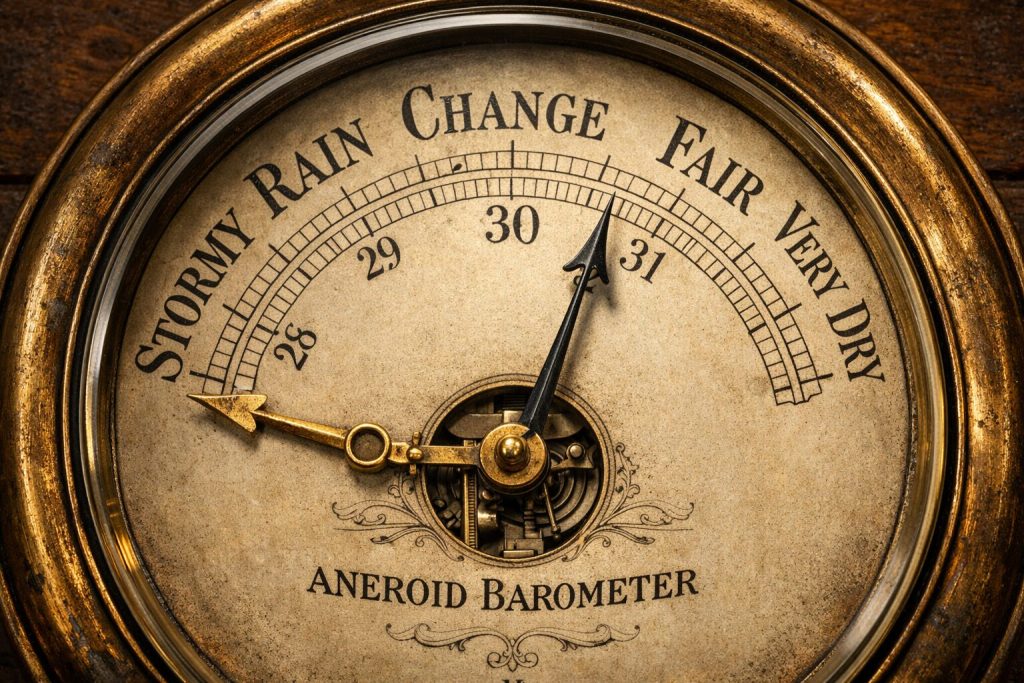
Most aneroid barometers show atmospheric pressure in hPa or millibars, often around 960–1050 hPa.
Some, especially in the United States, also show inches of mercury, usually around 28–31 inHg.
Many decorative faces include old-fashioned words:
RAIN
CHANGE
FAIR
VERY DRY
They are useful as atmosphere, but not as absolute prophecy.
The real value is not only the number.
It is the movement.
A rising pressure trend usually suggests improving or more stable weather.
A falling pressure trend often suggests worsening weather, wind, rain, or an approaching low-pressure system.
This is why many barometers have a second adjustable pointer, sometimes called a set hand. Each morning, you turn the set pointer to match the current needle position. Later, you check whether the needle has moved above or below that mark.
If it rises, the air is becoming heavier.
If it falls, the sky is loosening its grip.
That is the ritual.
The barometer does not predict the future like a fortune teller.
It reads the present more carefully than you do.
The Triptych Display – Barometer, Thermometer, Hygrometer
How Victorians Displayed Instrument Sets
A single barometer is strong.
A set is stronger.
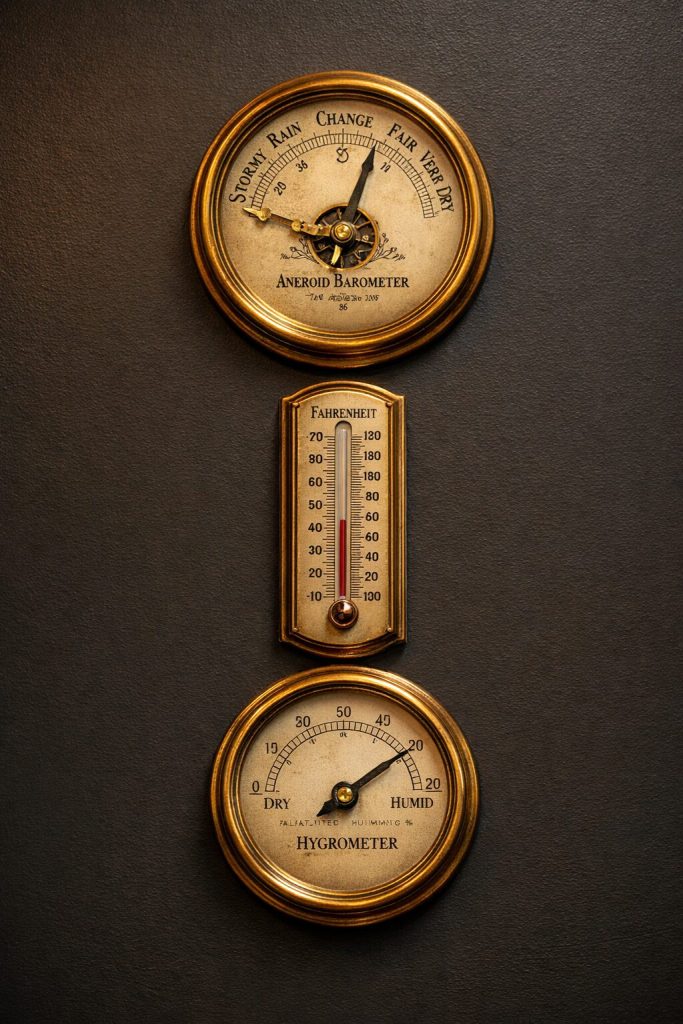
The classic Victorian arrangement is a kind of instrument triptych: barometer, thermometer, and hygrometer displayed together. Sometimes they appear in one vertical case. Sometimes they are separate matching instruments arranged symmetrically on a wall.
The logic is elegant.
The barometer reads pressure.
The thermometer reads temperature.
The hygrometer reads moisture.
Together, they turn a wall into a weather station.
This is exactly the kind of display that belongs in a Steampunk collector’s workshop. It is not clutter. It is a system. Three instruments, three measurements, one shared language of brass, glass, and calibrated faces.
On pipe bracket shelves, this kind of set works especially well because the industrial structure supports the instrument narrative. For display surfaces that can carry these groupings, see steampunk shelving systems – displaying instrument triptychs on pipe bracket shelves.
Styling a Modern Steampunk Instrument Triptych
The first rule is finish unity.
If the barometer is brass, the thermometer and hygrometer should also be brass or close enough in tone to feel intentional. A brass barometer beside a chrome thermometer usually looks accidental.
The second rule is backing.
These instruments look best against:
- dark wood paneling
- exposed brick
- charcoal wall paint
- deep green wall paint
- aged plaster
- walnut shelving
- black iron pipe brackets
The third rule is height.
Mount the center of the arrangement around 60–66 inches from the floor, close to eye level. These objects reward close reading. Mounting them too high turns them into vague brass circles.
Good flanking objects include:
- framed maritime chart
- brass compass
- small specimen jars
- dark wood shelf
- leather-bound notebook
- antique map reproduction
- clock or pressure gauge nearby
The triptych should feel like a working wall, not a random collection.
Calibrating and Maintaining a Barometer
Initial Calibration
A barometer must be calibrated before you trust it.
The simplest method is to look up the current sea-level pressure from a reliable local weather service. Do not use raw station pressure unless you understand the difference. Most home barometers are intended to display sea-level adjusted pressure so readings can be compared across locations.
Then find the adjustment screw on the back of the barometer.
Turn it gently until the needle matches the current pressure reading.
After adjustment, let the barometer sit for about 30 minutes, then check again. Small mechanical systems sometimes need time to settle.
Do not obsess over perfect precision.
For home use, the trend matters more than the exact number. A barometer that consistently shows rising and falling pressure correctly is doing its job.
Long-Term Maintenance
A good aneroid barometer does not ask for much.
Dust it lightly with a soft brush or microfiber cloth. Avoid spraying cleaner near the case vents or dial. Do not poke the mechanism from the back. Do not hang it in direct sunlight, next to a heating vent, or in a bathroom where humidity swings heavily.
Once a year, compare it against a current weather-service pressure reading and recalibrate if needed.
If the case is brass, clean it carefully. Some collectors prefer a polished brass shine. Others prefer a deeper patina. Both are valid, but be consistent with the rest of the room.
For surface care, see our complete brass instrument maintenance guide.
How to Actually Read a Barometer Day by Day
A barometer becomes more interesting when you stop treating it like a decorative dial.
Use it daily.
In the morning, set the pointer to match the needle.
Later in the day, check movement.
If the needle rises clearly, expect more stable or improving weather. If it falls slowly, change may be coming. If it drops quickly, the atmosphere is shifting more aggressively.
A sudden pressure drop is often more meaningful than a low number that has stayed steady.
That is the mistake beginners make.
They read the word “RAIN” and assume rain is guaranteed.
But weather is dynamic. A barometer is most powerful when read as a trend instrument. The needle’s movement is the story.
In a Steampunk room, this daily ritual matters.
It turns the object from prop into practice.
The collector does not merely own the instrument. The collector consults it.
Why Steampunk Collectors Love Barometers
A barometer belongs in Steampunk because it sits at the intersection of several obsessions:
Weather – the old human need to read the sky.
Mechanism – pressure translated through capsule, lever, and needle.
Brass and glass – the materials of instrument culture.
Display – science made worthy of the wall.
Ritual – setting the pointer and watching the change.
Precision – not digital convenience, but analog attention.
It also pairs beautifully with the other Steampunk object families.
Beside a clock, it creates a wall of measurement: time and pressure. Beside a thermometer, it becomes part of a weather station. Beside maps and nautical instruments, it suggests navigation. On a shelf with specimen jars and brass tools, it becomes part of a collector’s working language.
This is why a barometer should not be treated as filler.
It is an instrument with presence.
Final Placement Advice
A barometer should be easy to see and easy to reach.
Mount it where you can set the pointer without stretching. Keep it out of harsh direct sunlight. Place it near other instruments if possible. Let the finish match the surrounding metal palette.
If your room already has brass clocks, choose a brass barometer.
If your room leans darker, with black iron shelving and oxidized metal, choose aged brass or darkened brass rather than bright polished gold.
If your room has a maritime thread – maps, compass, telescope, ship’s bell – the barometer becomes almost mandatory.
It is the instrument that makes the whole wall feel less like decoration and more like preparation.
The sky changes.
The needle knows first.
For building the larger room around instruments, clocks, and display surfaces, see building a complete steampunk collector’s workshop – instruments, clocks, and display.


