
Before industrial shelving became something people searched for online, before it appeared in apartments with exposed brick and warm Edison bulbs, and before it became a phrase printed in product titles, it had a much simpler job:
hold weight.
It held tools, machine parts, boxes of castings, bolts, gauges, leather belts, glass jars, spare gears, oil cans, and whatever else the factory floor needed within reach. No one in a Victorian factory stood back and said, “This racking has excellent interior design potential.”
The shelves were not trying to be beautiful.
That is why they became beautiful.
Their lines came from use, and their materials came from necessity. Wrought iron, cast iron brackets, rough planks, exposed bolts, vertical uprights, and darkened surfaces were not decorative decisions; they were answers to pressure, weight, dust, and repetition.
And somehow, 150 years later, those same answers ended up in living rooms, studies, kitchens, lofts, and Steampunk interiors. Not because the shelf changed completely, but because we changed how we looked at it.
The Shelf That Held the Industrial Revolution – Before It Held Your Books
A modern Steampunk shelf carries strange cargo: old books, brass clocks, mechanical models, amber glass, rolled maps, maybe a small skull with gears around it, maybe a pipe lamp glowing nearby.
But the ancestor of that shelf carried heavier and less romantic things: machine parts, inventory bins, tools, coal-dusted ledgers, spare fittings, metal stock, and boxes labeled by hand. The original factory racking system was built for speed and survival. A worker needed to find the correct part quickly, a foreman needed inventory visible, and a mechanic needed tools above the bench rather than hidden behind polished cabinet doors.
That created a particular visual language: open storage, visible support, repeated verticals, heavy brackets, exposed fasteners, rough timber, and iron darkened by work.
No designer planned this aesthetic.
Industry simply built what it needed.
That is why industrial shelving still feels powerful today. It does not ask to be admired; it looks like it can take the weight. In a Steampunk interior, that matters more than polish because a shelf should not feel fragile beneath brass and leather. It should feel like part of the same machine as the room itself.
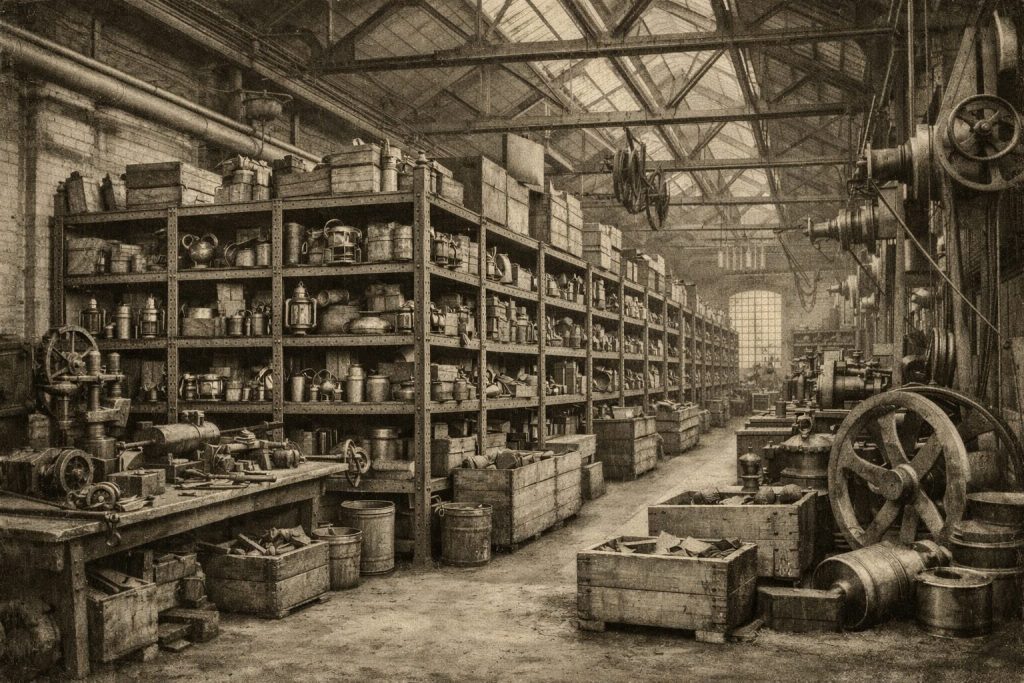
Victorian Factory Racking, 1850s-1900s
The Victorian era did not separate function and ornament as cleanly as modern design often does. A machine could be useful and still have curves. A bracket could hold weight and still carry a cast detail. A factory could be filthy, dangerous, and repetitive, yet still contain ironwork that feels almost sculptural today.
This is one reason Steampunk design keeps returning to the nineteenth century.
The objects were practical, but they had bodies.
Materials of the Era – Victorian Iron
The material heart of early industrial shelving was iron.
Wrought iron appeared wherever strength and workability mattered. It could be shaped, riveted, bent, and used in structural supports. Angle sections became one of the universal industrial forms: simple, repeatable, and strong enough to build frames, supports, and racking.
Cast iron brackets were another important language. Cast iron was strong in compression, relatively affordable to reproduce once molds existed, and strangely generous with ornament. A bracket could be functional and still carry curves, ribs, scrolls, or small decorative details almost by accident.
That accident became part of the charm.
A Victorian bracket rarely looks like pure minimal engineering. It often looks as though function passed through a decorative mind before becoming metal.
Wood planks were usually not furniture wood. They were rough-sawn, imperfect, sometimes green, sometimes warped, and often darkened quickly by use. Their job was to hold things, not impress guests.
But time changed them.
Oil stains, scratches, dents, and uneven darkening gave factory planks the very surface character people now try to recreate with stains and faux aging.
In modern Steampunk shelving, real material still matters. For a product example, read why HITOMEN’s 1-inch iron pipe feels closer to real industrial hardware than lighter decorative pipe systems.
For modern finish work, read how to recreate the worn honesty of Victorian factory hardware on new brackets.
The Whatnot Shelf – Industrial’s Domestic Cousin
While factories were building storage out of iron and rough plank, Victorian parlors were building a gentler cousin: the whatnot shelf.
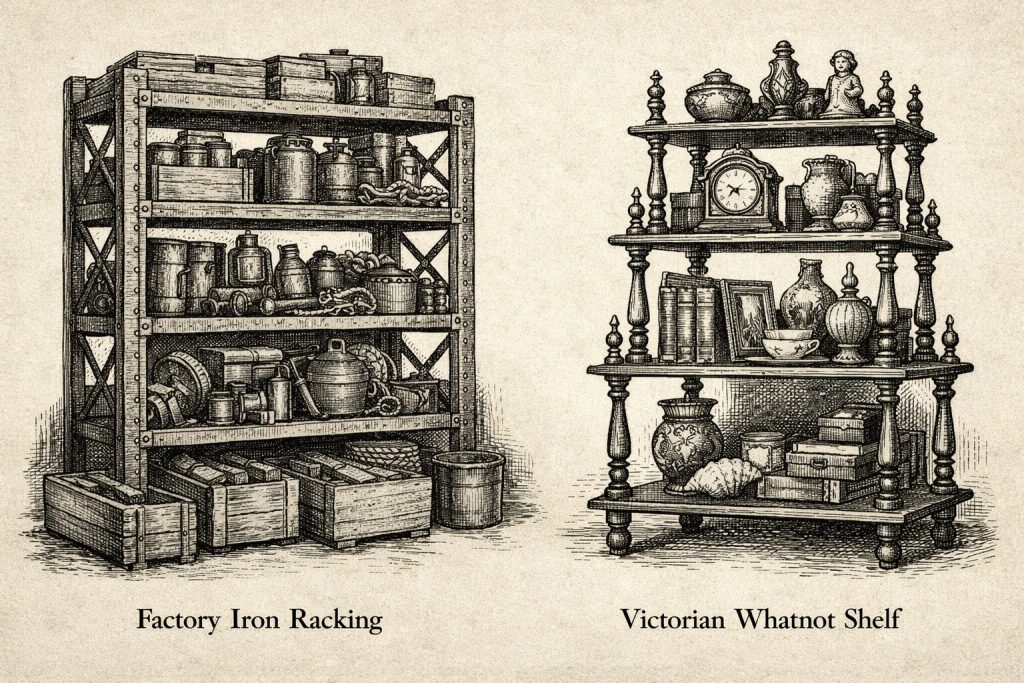
The whatnot was a tiered display shelf used for curiosities: small porcelain objects, shells, souvenirs, miniature sculptures, books, mementos, and objects that said something about taste, travel, class, and memory.
Structurally, the whatnot and the factory rack were not so different. Both were display systems. Both used vertical supports and horizontal shelves. Both organized objects so they could be seen.
The difference was language.
Factory racking spoke in iron, load, and access, while the whatnot spoke in polish, carving, and social display. One belonged to the workshop, and the other belonged to the parlor.
Steampunk shelving borrows from both.
That is why the best Steampunk shelf can hold heavy pipe energy while still displaying objects like a cabinet of curiosities. It is factory logic softened by Victorian collecting culture.
For that domestic ancestor, read the story of the Victorian whatnot shelf, the parlor display system hiding inside modern Steampunk shelving.
Early 20th Century – The Great Industrial Interior Divide, 1900s-1950s
By the early twentieth century, the visual world began changing. Factories expanded, offices modernized, libraries standardized, and ornament started losing its authority.
The shelf became cleaner, straighter, and more modular.
Less parlor.
More system.
Modernism’s War on Ornament
The early modernist movement treated ornament with suspicion. Adolf Loos famously attacked unnecessary decoration in the early twentieth century, arguing that ornament belonged to an outdated cultural stage. Whether one agrees with him or not, the influence of that thinking spread deeply through architecture and design.
Factories had already been moving in that direction for practical reasons. Less ornament meant easier production, easier cleaning, fewer breakable details, lower cost, faster installation, and more standardized parts.
Shelving became more skeletal: angle iron, steel uprights, bolted frames, adjustable holes, wooden or metal shelves. No carved flourishes, no decorative brackets unless structure required a rib or flange.
This is where the industrial aesthetic became more intentional, though still not in the lifestyle sense. It was not yet “industrial chic”; it was simply modern function becoming visually dominant.
Ironically, that stripped-down utility later became one of the strongest sources for modern industrial interior design.
Library Shelving and Its Institutional Influence
Factories were not the only source. Libraries had their own shelving revolution.
The growth of public libraries helped standardize durable shelving systems. Many institutional shelves used cast iron uprights, adjustable wooden shelves, and modular structures designed for heavy books and long-term public use.
These systems are direct ancestors of modern adjustable shelving. They were not delicate; they had to survive handling, weight, and decades of use. In some historic libraries, similar shelving systems still remain, carrying books with the same quiet authority they had a century ago.
This matters because the modern Steampunk shelf sits somewhere between factory rack and library stack.
It wants industrial honesty.
But it also wants display intelligence.
A proper Steampunk shelf should feel capable of holding both a gearbox and a first edition.
The Loft Era, 1980s-2000s – Industrial Shelving Enters the Home
The migration from factory to home did not happen because someone invented an aesthetic trend in a clean showroom.
It happened because factories emptied.
Manufacturing districts changed, and artists, designers, and people needing cheap space moved into old industrial buildings. They inherited brick walls, high ceilings, exposed pipes, concrete floors, steel columns, freight elevators, and leftover storage systems.
At first, the look was not styled.
It was simply there.
The New York Loft as Cultural Export
The New York loft became one of the most important bridges between industrial utility and domestic design.
Neighborhoods like SoHo, Tribeca, and later Williamsburg helped turn raw industrial interiors into cultural objects. Artists did not always remove the factory traces because those traces were useful, affordable, and visually powerful.
Old shelving stayed because it worked. Pipe stayed because rerouting it was expensive. Brick stayed because covering it felt unnecessary. Factory racking became storage, worktables became dining tables, and industrial lamps became room lighting.
The distinction between workspace and living space blurred.
That blur is central to Steampunk interiors today. A Steampunk room is rarely just a living room. It is usually also a study, archive, workshop, or laboratory of the imagination.
The loft era taught interiors to accept exposed structure as beauty.
Not polished beauty.
Honest beauty.
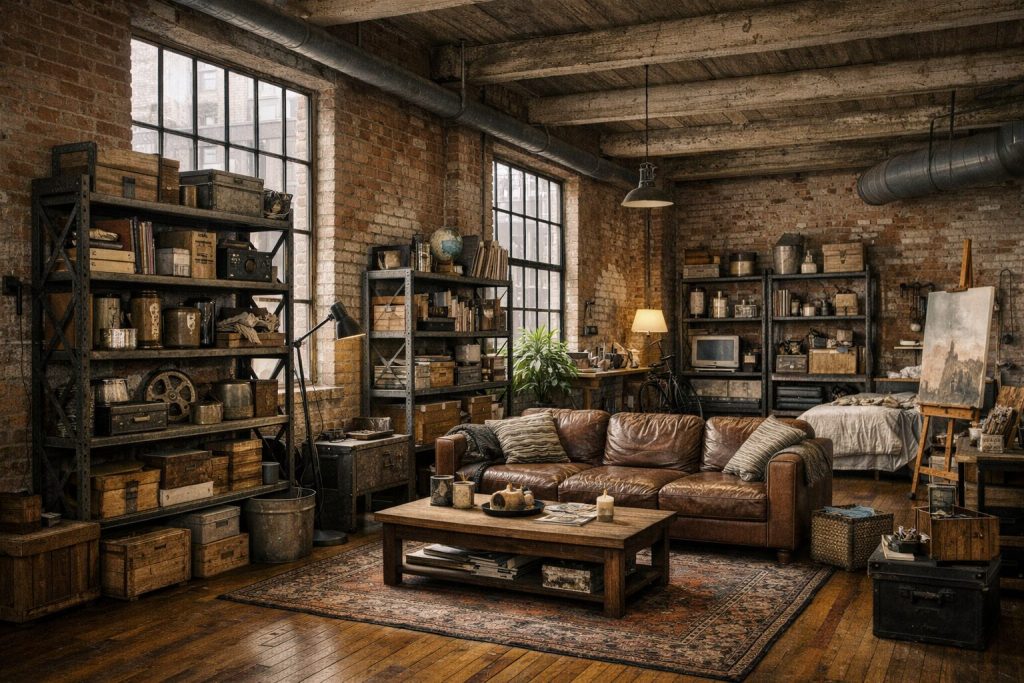
Restoration Hardware and Commercialization
Eventually, the aesthetic became commercial.
Brands began selling “factory” furniture, “industrial” shelving, and “loft-inspired” pieces to suburban homes far from the original manufacturing districts. The look became more accessible, and more people could bring pipe shelves, metal carts, and reclaimed-style wood into normal houses.
That democratization was not bad.
But something was diluted.
Original industrial shelving had material context. It came from work. It carried marks of use. It belonged to buildings where structure was visible because hiding it was unnecessary.
Commercial industrial furniture sometimes kept the silhouette but lost the material truth.
Pipes became lightweight decorative tubes. Brackets became cast imitations. Wood became veneer. Patina became paint.
This is where Steampunk design begins correcting the problem.
Steampunk’s Correction – Authenticity Over Decoration
Steampunk brought the Victorian timeline back into the conversation.
Not all industrial interiors care whether a pipe shelf feels nineteenth-century, early modernist, or generic warehouse. Steampunk shelving does.
That historical intention is the difference.
A generic industrial shelf says, “This looks like a factory.”
A Steampunk shelf says, “This could belong to a Victorian workshop, engineer’s study, airship cabin, or gaslight-era archive.”
That requires more than black metal and brown wood. It requires the right material story: black iron pipe, cast iron brackets, dark or reclaimed wood, visible fasteners, believable patina, structural honesty, and display logic borrowed from Victorian collecting.
This is also where modern products can fail. A shelf may look industrial in a listing but feel wrong in person if the pipe is hollow, the finish too glossy, or the wood too artificial.
For a modern case study, read the BIXIRAO material controversy and what it reveals about industrial look versus industrial material.
That distinction is the heart of Steampunk shelving.
Industrial look is surface.
Industrial material is evidence.
For products that carry the lineage more convincingly, read the Steampunk industrial shelf ranking built around material credibility, load, and visual history.
What This History Means When You Buy a Shelf
A shelf does not need to be antique to be authentic, but it should understand what it is referencing.
Before buying, ask these questions:
Does the bracket look structural or merely decorative? Is the pipe size believable for the shelf scale? Does the wood surface look like material with grain, weight, and age, or like printed texture? Are the fasteners visible in a way that supports the industrial language? Does the finish have depth, or does it look sprayed on?
Would this shelf still look convincing if it held heavy books and brass objects? Does the design belong more to Victorian workshop, factory racking, library shelving, or generic modern farmhouse?
None of these questions require perfection.
They require intention.
Because the best industrial shelving does not simply hold objects. It continues a material history that began with factories, passed through parlors, libraries, lofts, and finally arrived in the modern Steampunk room.
The shelf held the Industrial Revolution before it held your books.
That history is still visible if you choose carefully.
And when the shelf is right, the room feels less decorated: more inherited, more worked-in, and more alive.
For carrying that material history into the larger room design, read how industrial shelving history fits inside a complete Steampunk living space.


