
A Steampunk shelf can fail even when every object on it is beautiful. That is the strange part.
You can own the right things: a brass compass, a pocket watch, a cast iron gear, a stack of old books, a small Edison lamp, a weathered map, maybe a glass vial or a miniature steam engine. Each one feels correct in your hand, with the right color, texture, and little whisper of another century.
Then you place them all together, and somehow the shelf becomes noise.
Not because the objects are wrong, but because the display has no governing idea. The viewer’s eye sees metal, paper, wood, glass, and leather, yet it does not know where to begin. There is no story, no hierarchy, and no clear reason these pieces have gathered in the same place.
Every compelling Steampunk shelf display needs an organizing principle. There are two dominant ways to organize a collection: theme, which groups objects by what they mean, and material, which groups objects by what they are made of.
Both can be powerful. Both can create a shelf that feels intentional, cinematic, and alive. The problem begins when people mix both systems accidentally: a few brass objects, one random map, two gears, a glass bottle, a leather journal, a modern figurine, and a clock all fighting for attention on the same plank.
At that point, the shelf looks less like an archive and more like a box of props poured onto wood.
A serious collector does not merely display objects.
A serious collector chooses the logic that holds them together.
Before building the display, make sure the foundation can support the objects properly. Start with the shelf systems that make a serious Steampunk display possible before the collection takes over the wall.

The Two Philosophies of Display – And Why Choosing One Matters
A shelf is never neutral. The way you group objects tells the viewer how to read them.
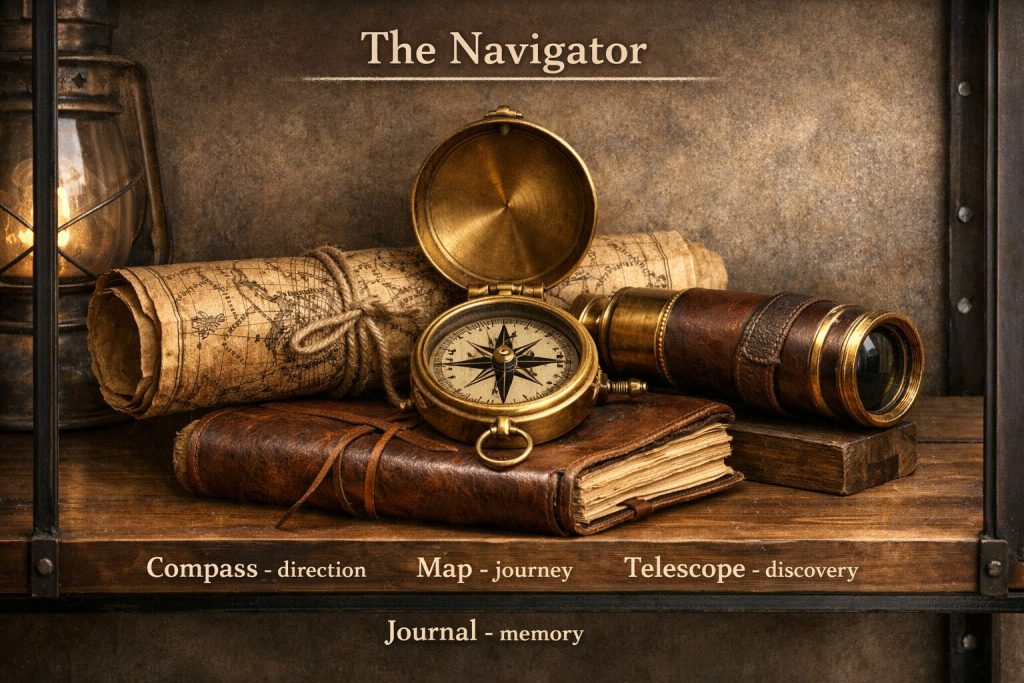
If you group a compass, rolled map, sextant, and telescope, the shelf begins telling a travel story. The viewer does not need an explanation because the objects point toward navigation, distance, weather, ships, and unknown coastlines.
That is thematic grouping.
If you group a brass clock, brass gear, brass magnifying glass, brass candle holder, and brass compass, the shelf communicates something else. Not a specific story, but an atmosphere: warmth, amber reflection, mechanical refinement, and old-world precision. The objects may have different functions, but their shared material creates a unified world.
That is material grouping.
Both approaches work, but they work differently. Theme gives the shelf narrative, while material gives the shelf mood. A theme-based display feels like a scene from a life; a material-based display feels like an environment with a strong sensory identity.
Most failed displays happen because the collector uses both principles at once without deciding which one is in charge. The shelf contains navigator tools, scientist objects, brass objects, iron objects, random books, and small decor, all trying to become the organizing idea.
The result is visual noise.
A strong shelf chooses a philosophy first.
Then it lets the objects obey.
Grouping by Theme – The Narrative Approach
A theme-based Steampunk display asks one question: “What story is happening here?”
Not every object needs to be historically accurate, and not every piece must be antique. But each object should feel like it belongs to the same imagined scene. This is where Steampunk decor becomes more than a look; it becomes worldbuilding.
Steampunk Narrative Archetypes
Certain archetypes appear naturally in Steampunk interiors because they already belong to the genre’s emotional machinery.
The Navigator
This cluster belongs to distance.
Use a brass compass, rolled maps, a sextant, a telescope, a ship’s bell, a small globe, or a weathered travel journal. The mood is salt air, chart tables, candlelit cabins, and instruments sliding slightly as the ship moves.
This cluster works beautifully on darker wood, especially near brass lighting or a warm wall sconce.
The Scientist
This cluster belongs to experiment.
Use glass flasks, specimen jars, magnifying glasses, old chemistry cards, clockwork models, botanical prints, or a small laboratory lamp. The mood is amber light through glass, dust on metal instruments, and a desk that still smells faintly of alcohol burner and paper.
This theme benefits from contrast: transparent glass against dark iron, small labels, aged paper, and one strong metal anchor.
The Engineer
This cluster belongs to function.
Use gears, technical drawings, a slide rule, steel ruler, miniature steam engine, pipe fittings, small tools, or mechanical sketches. The mood is workshop bench, pressure gauges, oil cloth, and the sound of something being tightened into place.
This is one of the easiest themes to overdo. Too many gears turn the shelf into costume, so one or two strong mechanical objects are usually enough.
The Adventurer
This cluster belongs to motion and survival.
Use goggles, leather journals, canteens, specimen jars, pocket watches, field notes, and small travel cases. The mood is field expedition, desert dust, train stations, sealed letters, and rain on canvas.
This theme works especially well when leather, brass, and aged paper appear together.
For curated object choices by story type, read the small Steampunk decor guide that helps you build narrative clusters without turning the shelf into a prop box.
Building a Theme Cluster
A good theme cluster needs structure.
Start with one core object. This is the narrative center, so it must be immediately readable. For the Navigator, the core might be a compass. For the Scientist, it might be a glass flask or magnifying lens. For the Engineer, it might be a gear or technical drawing. For the Adventurer, it might be a journal or pair of goggles.
Then add supporting objects. Two to four pieces are usually enough, and they should reinforce the story without repeating the same idea too literally. Finally, add one texture object. This object does not need to explain the theme directly, but it adds surface interest: leather, glass, paper, dark wood, iron, or brass.
A strong cluster usually contains 5-7 objects maximum. After that, clarity begins to fade.
The shelf should feel like a scene, not a storage tray.
When Theme Grouping Breaks Down
Theme grouping fails in two common ways.
The first failure is that the theme becomes too obscure. You may understand why a certain key, bottle, map, and metal box belong together because they remind you of an imagined airship mechanic from a story in your head. But the viewer sees unrelated objects. Private meaning is not enough; the display needs enough visual clues for the story to become readable.
The second failure is that the theme becomes too literal. A shelf with seven compasses is not a Navigator cluster. It is a compass collection. That may still be interesting, but it loses narrative depth.
The fix is one unexpected object.
For a Navigator cluster, add a dried botanical specimen from an imagined voyage. For a Scientist cluster, add a burned notebook corner. For an Engineer cluster, add a small sealed envelope beside the technical drawing. For an Adventurer cluster, add a hotel key or train ticket replica.
The unexpected object deepens the story.
It gives the shelf a second layer.
Grouping by Material – The Environmental Approach
Material grouping asks a different question: “What should this shelf feel like before the viewer even understands the objects?”
Instead of organizing by story, it organizes by surface. Brass, iron, wood, leather, glass, and paper each carry their own emotional temperature. When one material dominates, the shelf becomes visually coherent very quickly.
This approach is especially useful when your objects do not share a clear theme but do share a strong material identity.
The All-Brass Shelf
An all-brass shelf is warm, rich, and immediately Steampunk. It catches amber light better than almost any other material group. A brass compass, brass lamp base, brass candlestick, brass gear, brass magnifier, and brass clock can create a shelf that feels like a Victorian instrument table.
But there is a risk: monotony.
If material unifies everything, form must vary. Do not use six brass objects of similar size and shape, because the shelf will become a golden blur.
Instead, combine radically different forms: one round object like a clock or gauge, one vertical object like a candlestick or small lamp, one flat object like a brass tray, one detailed object like a compass, and one irregular object like a gear or mechanical fragment.
A Steampunk clock or pressure-style gauge often makes the strongest anchor in this type of grouping. For anchor ideas, read why Steampunk clocks and gauges often become the natural center of a brass shelf display.
The Iron and Wood Shelf
An iron and wood shelf feels more masculine, raw, and workshop-appropriate. Where brass glows, iron absorbs. Where brass suggests navigation and measurement, iron suggests labor and structure.
This shelf might include cast iron bookends, a raw steel gear, an iron paperweight, a wooden box, a black pipe fitting, and a dark book stack.
The contrast inside the material group matters. Rough-cast iron beside smooth-planed wood creates tension. Blackened steel beside walnut creates weight. A small brass accent can be introduced, but sparingly.
Iron-and-wood displays work best in rooms with black pipe shelving, exposed brick, darker desks, industrial sconces, leather seating, concrete, or plaster walls.
This is the shelf that feels most like a workshop.
Mixed Metal Strategy
Material grouping does not require absolute purity.
One accent metal is allowed. In fact, one accent can make the shelf better.
An all-brass shelf with one copper piece gains a focal point. An iron-and-wood shelf with one brass clock becomes warmer. A copper-heavy shelf with one black iron bracket gains grounding.
The accent metal should sit near the visual center of gravity. Do not scatter accent pieces everywhere, because that defeats the purpose.
Use the accent like a spark.
One bright detail inside a darker machine.
For shelves with multiple tiers, read how the BIXIRAO adjustable frame helps each material group breathe instead of crowding into one level.

Combining Both – The Advanced Approach
The strongest displays often combine theme and material, but only after each system is understood separately.
The advanced method is simple: build thematic clusters using material consistency inside each cluster.
For example, create a Navigator cluster in brass, an Engineer cluster in black iron, a Scientist cluster in glass and steel, and an Adventurer cluster in leather and aged paper. Now the shelf has both story and visual order. Each cluster tells a different narrative, but the material palette keeps the overall display from becoming chaotic.
The transition between clusters matters.
A transition object is a piece that belongs to both worlds. Between Navigator and Scientist, use a magnifying glass over a map. Between Engineer and Adventurer, use a pocket watch beside a field notebook. Between brass and iron, use an aged gauge with a brass face and black metal case.
That object becomes a bridge.
Not filler.
For composition rules that help keep combined displays balanced, read how odd-number grouping keeps theme-and-material displays from turning into clutter.
If your shelf system has four vertical tiers, theme separation becomes easier. For vertical display planning, read how HITOMEN’s 4-tier system gives different themes enough room to stay readable.
Practical Display Building Exercise
Start with everything off the shelf.
Completely empty.
A shelf cannot be properly curated while half the objects are still sitting there asking to stay.
Now sort your objects into two groups. First, sort by theme: Navigator, Scientist, Engineer, Adventurer, Scholar, Timekeeper, and Workshop. Then sort again by material: brass, iron, copper, wood, leather, glass, and paper.
Now look for overlap.
A brass compass belongs to Navigator and brass. A steel ruler belongs to Engineer and iron. A leather journal belongs to Adventurer and leather. A glass flask belongs to Scientist and glass.
These overlap objects are your strongest pieces, so build from them outward. Choose one overlap object as the anchor. Add two supporting objects. Add one texture object. Then stop.
Step back.
If the cluster reads clearly from six feet away, it works. If it only makes sense when you explain it, simplify.
A good Steampunk shelf display should be readable before it becomes detailed. The viewer should feel the story first, then discover the smaller pieces afterward.
Final Thoughts
Theme and material are not enemies. They are two different ways of creating order.
Theme tells the viewer what happened here, while material tells the viewer what kind of world this is. A shelf organized only by theme can become visually scattered if every object is a different color, texture, and finish. A shelf organized only by material can become beautiful but empty if the objects have no narrative relationship.
The best Steampunk displays eventually learn to use both.
A brass Navigator cluster. An iron Engineer cluster. A glass-and-steel Scientist cluster. A leather Adventurer cluster. Each one a small scene, and each one part of a larger room.
When the shelf is done well, the objects stop looking arranged. They look as if they were placed there after use: a compass set down beside a map, a clock left running, a gear waiting for a machine that may never be rebuilt.
That is when display becomes atmosphere.For bringing this philosophy into the rest of the room, read how display logic fits into the complete Steampunk room design system.


