
A single barometer on a wall says the room pays attention to weather.
A barometer, thermometer, and hygrometer arranged together say something larger.
They say the room believes the air is worth reading.
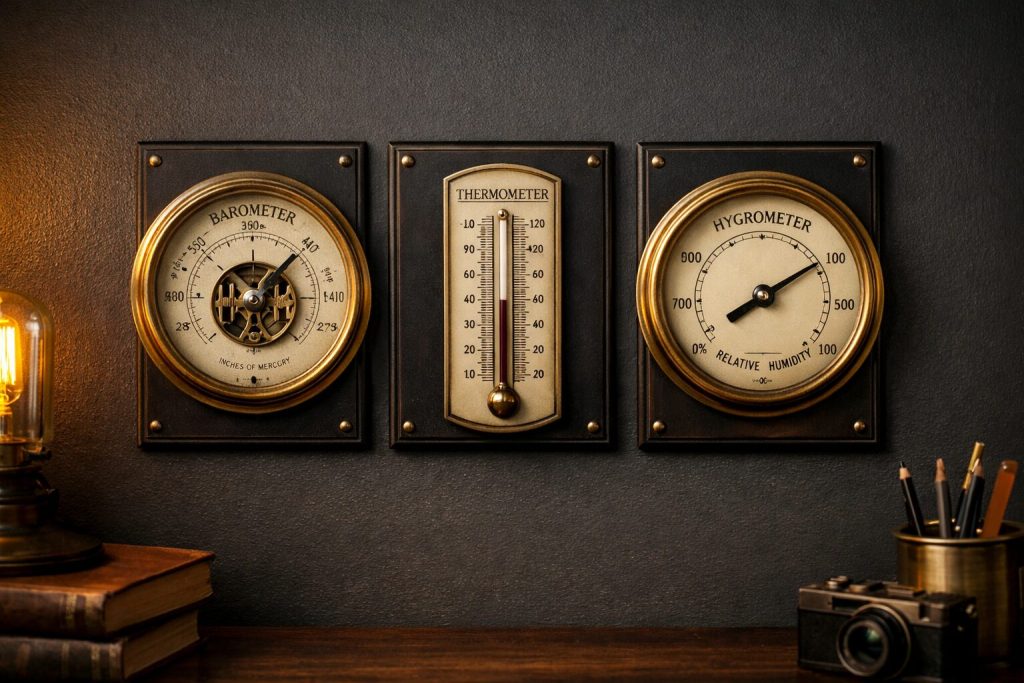
That is why the Steampunk instrument triptych works so well. It is not random decoration. It is a small domestic weather station: one instrument for atmospheric pressure, one for temperature, one for relative humidity. Three faces. Three needles or scales. One shared purpose.
In a Steampunk collector’s workshop, this kind of display feels completely natural. It belongs beside brass clocks, pipe shelves, old maps, specimen jars, leather journals, and scientific instruments. It turns a wall into something more intelligent than a gallery.
The room stops merely looking old.
It starts measuring.
For the clock-and-instrument context around this display style, see our steampunk clocks and instruments – adding a triptych to your collection.
The Victorian Weather Station – History of the Domestic Instrument Display
The Victorian home loved measurement.
Not in a sterile laboratory sense, but in a domestic, almost ceremonial way. A well-kept home could display clocks, barometers, thermometers, hygrometers, maps, globes, and optical instruments as signs of education and order.
The world was changing quickly. Railways compressed distance. Telegraphy compressed communication. Steamships crossed oceans. Scientific societies published discoveries. Weather itself began to feel less like fate and more like something that could be observed.
So the wall became a place for instruments.
A matched barometer, thermometer, and hygrometer set made sense because the three instruments measured related phenomena. Pressure, heat, and moisture all describe the condition of the air. Together, they formed a domestic weather station: practical, educational, and beautiful.
That is why the triptych feels so correct in modern Steampunk decor.
Steampunk does not only want objects that look antique. It wants objects that behave as if knowledge matters.
A weather instrument triptych does exactly that.
It gives the wall a job.
Instrument Functions – What Each Measures
Barometer – Atmospheric Pressure
The barometer measures atmospheric pressure.
On most analog barometers, the scale appears in hPa, millibars, mmHg, or inHg depending on the instrument’s origin and market. Many traditional faces also include old weather words like RAIN, CHANGE, and FAIR.
Those words are useful, but they should not be read too literally.
A barometer is strongest when read as a trend instrument. If pressure falls, a low-pressure system may be approaching, often bringing unsettled weather. If pressure rises, conditions may stabilize or clear.
The most important reading is not only where the needle is.
It is where the needle was earlier.
That is why a barometer belongs at the center of the triptych. It is the most complex instrument, the most visually commanding, and the one most closely associated with old maritime and scientific interiors.
For reading and calibration details, see our complete barometer reading and calibration guide.
Thermometer – Temperature
The thermometer measures ambient air temperature.
In a Steampunk display, the best visual format is usually a slim brass or dark-metal vertical thermometer with a glass tube and dual scale: °F and °C. The Fahrenheit scale serves the American market; the Celsius scale adds European and scientific character.
Many antique thermometers used mercury. Most modern reproductions use safer liquids such as alcohol or other colored fluid. For home display, that is a good thing. Steampunk does not require dangerous materials to feel authentic.
The thermometer is usually visually narrower than the barometer, so it works well as one of the side instruments.
It gives the display vertical contrast.
The barometer reads pressure.
The thermometer reads heat.
The wall begins to feel like a small station rather than a decorative cluster.
Hygrometer – Relative Humidity
The hygrometer measures relative humidity – the amount of moisture in the air compared with how much the air could hold at that temperature.
Traditional hygrometers often used organic materials such as human hair or gut string because they expand and contract with humidity. Modern versions may use hair, synthetic fiber, or polymer sensors.
The display is usually a dial marked from 0–100%, often with zones such as DRY, NORMAL, and DAMP.
A hygrometer adds a subtle but important layer to the triptych.
It makes the display feel less like “weather decor” and more like an actual instrument wall. Pressure alone tells one story. Temperature tells another. Humidity completes the atmosphere.
In a room full of wood shelves, old books, brass objects, and clock cases, humidity is not only decorative information. It matters. Too much moisture affects metal, paper, leather, and wood.
The hygrometer quietly watches over the collection.
Triptych Arrangement – The Composition Rules
Spacing and Alignment
A Steampunk instrument triptych works because the three instruments read as one composition.
That means alignment matters.
Use a shared horizontal centerline. The center of the barometer, thermometer, and hygrometer should sit at the same height, even if the objects have different shapes. Do not align by top edge unless all three instruments share the same frame size. Center alignment feels more natural and more formal.
Spacing should usually be around 4–6 inches between instruments.
Closer than that, the display may feel cramped. Wider than that, the three pieces may stop reading as a set and begin looking like unrelated objects scattered across the wall.
The strongest arrangement is usually:
Thermometer – Barometer – Hygrometer
or
Hygrometer – Barometer – Thermometer
The barometer should stay in the center because it is usually the widest and most visually important. The two side instruments act like attendants.
Symmetry is not boring here.
It is the point.
Mount Surface
The surface behind the instruments decides whether the triptych feels unified or scattered.
A dark wood backing panel is the safest choice. It gives the three instruments one visual field and makes the display feel like a single mounted station rather than three separate purchases.
Good backing surfaces include:
walnut, dark-stained pine, reclaimed oak, charcoal-painted board, blackened wood, or aged plywood sealed with oil.
Direct wall mounting can also work if the wall already has texture and depth: exposed brick, dark plaster, slate, or deep green paint. On a plain light wall, however, small brass instruments can look weak and disconnected.
If the wall is light, use a backing panel.
The panel becomes the frame.
For shelving and backing surfaces that support this kind of instrument display, see steampunk pipe shelves – creating a backing surface for instrument triptych display.
Total Width Calculation
Before hanging anything, calculate the total width.
A typical small instrument may be 4–5 inches wide. Three instruments plus two gaps of 4–6 inches creates a total width around 18–24 inches.
That size is ideal above a narrow console, beside a reading chair, over a small shelf, or as part of a larger collector’s wall.
Mark the center point of the full composition first.
Then mark the center of the barometer.
Then mark the two side instruments from that point.
A laser level makes this easier, especially because three small objects will reveal even slight height errors. If one instrument sits a little high, the wall will feel nervous.
The triptych should feel measured.
Because measurement is what it is about.
Sourcing a Matched Set
Pre-Matched Sets
The easiest path is buying a pre-matched set.
On marketplaces like Amazon and Etsy, you can find reproduction barometer, thermometer, and hygrometer sets designed to match in size, finish, and frame style.
The advantage is obvious: one purchase, one finish, one visual language.
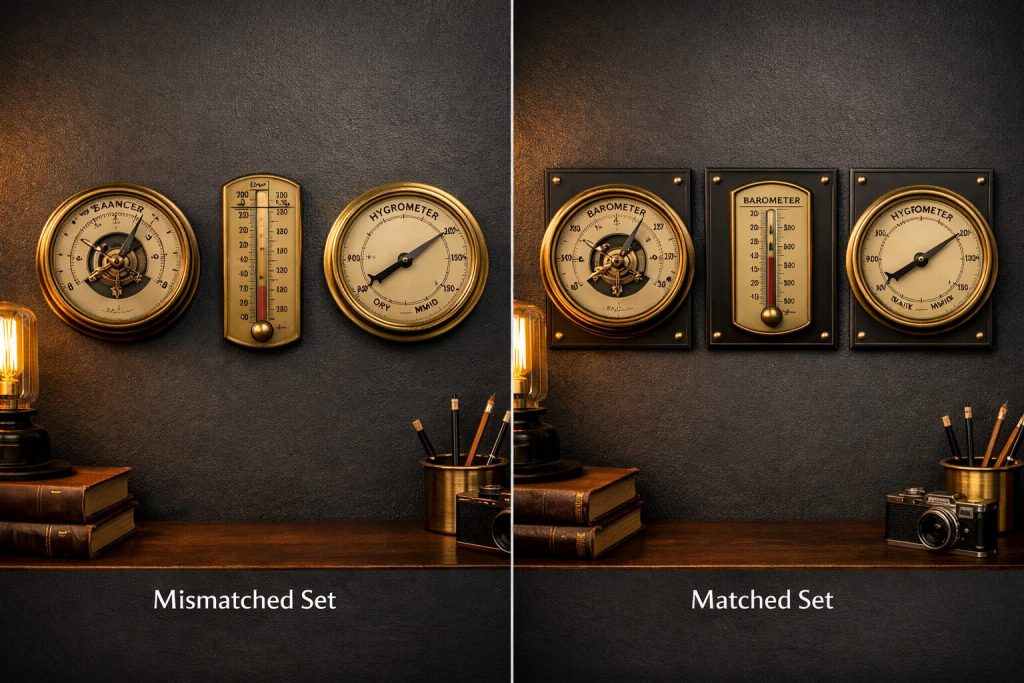
That matters because mismatched brass can be surprisingly noticeable. One instrument may be polished yellow brass. Another may be antique brass. Another may lean bronze. Individually, all three might look good. Together, they may look accidental.
A matched set solves that.
The drawback is quality compromise. A set may include one strong instrument and two weaker ones. Usually, the barometer matters most because it is the most mechanically complex. A mediocre thermometer is less troubling than a poor barometer.
If you choose a matched set, check the barometer first.
The center instrument carries the display.
Sourcing Individually for Quality
The more serious collector’s path is sourcing each instrument individually.
Start with the best barometer you can find. Choose the case shape, finish, size, and dial style first. Then source a thermometer and hygrometer that match its tone.
This creates a more characterful display, but it requires patience.
Good sources include:
nautical antique stores, estate sales, scientific instrument dealers, Etsy specialty sellers, flea markets, and vintage decor shops.
The key is visual cohesion. The three instruments do not need to be identical, but they must feel related. Similar brass tone, similar scale, similar dial language, and similar mounting style are enough.
Matched sets are convenient.
Individually sourced sets feel collected.
For small objects that can support the instrument wall nearby, see our steampunk small decor guide – instruments alongside figurines and artifacts.
Functional Use – Making the Instruments Work for You
A triptych becomes more powerful when you actually use it.
Start with the barometer.
Each morning, set the reference pointer to the current needle position. Later, check whether pressure has risen or fallen. A change of more than 3 hPa over three hours is worth noticing. It suggests that the weather system is shifting with intent.
Then read the thermometer.
Is the room temperature stable? Does the room get warmer in afternoon light? Does your study cool sharply at night? This matters for comfort, but also for wood, books, and instruments.
Then read the hygrometer.
A room full of paper, leather, wood, and brass does not love extreme humidity. Very dry air can affect wood and bindings. Damp air encourages tarnish, rust, mildew, and paper damage.
A good Steampunk room is not only styled.
It is maintained.
For a more period-correct ritual, keep a small leather journal nearby. Record daily pressure, temperature, humidity, and a short weather note.
Rain coming.
Pressure falling.
Room dry.
Brass beginning to tarnish.
Window condensation in morning.
This turns the display from decoration into practice.
The Victorians would understand.
Where to Place the Triptych in a Steampunk Room
The best place is somewhere visible but not chaotic.
Avoid walls already crowded with art, shelves, sconces, and clocks. Instruments need clarity. Their faces are small. Their markings deserve to be read.
Strong placement options include:
above a writing desk
beside a reading chair
over a narrow console
near a window
above a pipe shelf
beside a large wall clock
inside a study corner
as part of a collector’s workshop wall
Do not place the triptych too high. Eye-level matters because these instruments invite close reading. A center height around 60–66 inches works well in most rooms.
If mounted above furniture, leave enough breathing room between the furniture top and the bottom of the backing panel or lowest instrument.
The display should feel intentional, not squeezed.
If there is a clock nearby, the relationship becomes even stronger: time and weather, side by side. One measures duration. The other measures atmosphere.
That is a wall with a mind.
Final Arrangement Formula
Use this simple formula for most Steampunk instrument triptych displays:
Place the barometer in the center.
Place the thermometer and hygrometer on either side.
Use a shared centerline.
Keep 4–6 inches between instruments.
Mount on a dark wood backing panel if the wall is light or plain.
Keep the full width around 18–24 inches unless the instruments are unusually large.
Use brass or aged metal finishes consistently.
Place at eye level.
Read the instruments daily.
Do not let them become props.
A barometer, thermometer, and hygrometer deserve better than being reduced to “vintage wall decor.” They are instruments. Let them measure. Let them gather small truths about the room.
A Steampunk display is strongest when the objects are still allowed to work.
For the larger room framework, see the complete steampunk workshop – instruments, clocks, and display.


