
Affiliate Disclosure: Some links in this article may be affiliate links from Amazon and Etsy. When you buy through them, The Mechanical Art may receive a small commission at no extra cost to you. Every product we mention is selected to match the industrial, mechanical, and steampunk-inspired spaces we love to explore.
Some clocks belong on a wall.
The Veronese Design Steampunk Octopus Clock Sculpture does not.
It belongs on a shelf, somewhere between a brass compass, a stack of leather-bound books, a specimen jar, and a shadow that moves when the desk lamp warms up. It is not the kind of clock you glance at from across the room to check whether you are late.
It is the kind of clock someone notices, leans closer to, and then asks about.
That distinction matters.
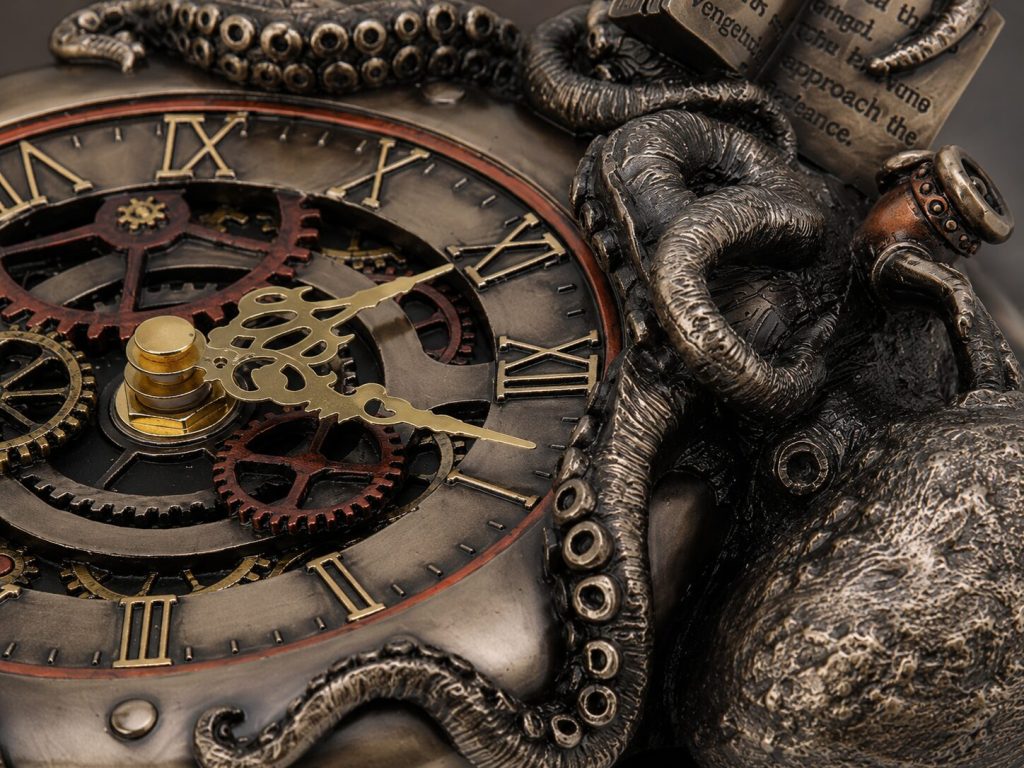
The Veronese Steampunk Octopus Clock is not primarily a timekeeping instrument. It is a cold cast bronze clock sculpture with a clock face embedded inside the object. The timekeeping is real, but secondary. The sculpture comes first. The clock follows.
That is why its review count should be understood differently from a mainstream wall clock. 44 reviews is not automatically a weakness here. This is a niche collector object, not a mass-market kitchen clock. Buyers do not stumble into something like this casually. They choose it because they already understand the visual language: octopus, gears, bronze, Victorian sea mythology, and clockwork.
In the full clock ranking, Veronese does not win by size, utility, or review volume.
It wins by Steampunk identity.
For the full comparison, see our complete steampunk clock ranking – where Veronese stands.

→ See Veronese Steampunk Octopus Clock on Amazon
Not a Clock That Looks Like Art – Art That Happens to Tell Time
The easiest mistake is judging the Veronese like a normal clock.
If you judge it that way, the clock face is small. The form is compact. It will not dominate a feature wall like the ImprovingLife Gears Clock. It will not give you hidden storage like the Abdurey Telephone Clock. It will not glow like a Nixie-style clock from ClocTeck or GUAZI.
But that is not its assignment.
The Veronese is a sculpture first.
Its job is to become a shelf anchor – the object around which smaller things arrange themselves. A compass beside it suddenly makes sense. A folded map becomes part of a voyage. A glass vial becomes a specimen from a drowned laboratory. A clock face inside an octopus becomes more than timekeeping. It becomes atmosphere.
That is the difference between Steampunk clock decor and a genuine collector object.
A decorative clock fills space.
A collector clock creates gravity.
The Veronese does that because it carries several Steampunk signals at once: bronze surface, octopus mythology, gear integration, clock face, and handcrafted sculptural detail. It does not need to be large because its narrative density is high.
You do not place it in the room because you need to know the hour.
You place it because the room needs a creature that knows what time means underwater.
Cold Cast Bronze – What You’re Actually Holding
The Manufacturing Process
The phrase cold cast bronze sounds vague until you know what it means.
A cold cast bronze object is typically made by mixing genuine bronze powder with a polyresin binder, then casting that mixture into a mold. Unlike foundry bronze, this process does not require molten metal. It is “cold” casting because the object is formed without pouring hot metal into a traditional foundry mold.
The result is not solid bronze.
But it is also not simple plastic.
A cold cast bronze surface contains real metal powder, which gives the object more depth, weight, and surface character than ordinary painted resin. It can feel more substantial in the hand. It can catch light more convincingly. It can develop a richer surface over time than acrylic paint over plastic.
That is why this material matters for Steampunk collectors.
Steampunk is sensitive to material dishonesty. A cheap plastic figurine painted bronze can look fine in a product photo, but on a shelf beside real brass, old books, iron brackets, and amber glass, it often fails.
Cold cast bronze has a better chance of surviving that scrutiny.
It is still a compromise compared with solid bronze. But it is a respectable compromise.
How Cold Cast Bronze Differs From Painted Plastic
The difference between cold cast bronze and painted plastic is not only visual.
It is tactile.
Painted plastic usually has a uniform surface. The metallic color sits on top. If it chips, the illusion breaks immediately. It warms quickly in the hand. It often has a hollow or lightweight feel.
Cold cast bronze behaves differently.
Because the surface contains real bronze powder, it can respond more like metal. It may feel slightly cooler at first touch. It has more convincing surface depth. It can be polished or aged more naturally than paint. Over time, depending on handling and environment, it may develop subtle patina effects.
That does not mean you should aggressively polish or chemically age it without care. The object still contains resin, and harsh treatment can damage detail.
But as a shelf object, cold cast bronze is far more convincing than ordinary painted plastic.
A simple test: touch it, tap it, and look at how light sits on the surface. Painted plastic reflects like coating. Cold cast bronze tends to hold shadow better.
That shadow is part of the value.
For care guidance, see caring for cold cast bronze and brass surfaces – metal finishing guide.
→ Check Veronese cold cast bronze clock on Amazon
The Octopus in Steampunk – Why This Motif Is Canonical
Jules Verne and the Nautilus Legacy
The octopus did not become a Steampunk icon by accident.
Part of its power comes from the Victorian imagination of the sea.
In Jules Verne’s world, the ocean was not simply water. It was an industrial frontier. It was pressure, machinery, navigation, unknown species, submarine engineering, and the terror of depth. 20,000 Leagues Under the Sea gave the Victorian and post-Victorian imagination one of its great visual marriages: advanced machinery moving through ancient darkness.
The Nautilus is not just a submarine.
It is a Steampunk room before Steampunk had a name.
Brass instruments. Mechanical systems. Scientific ambition. Isolation. Sea monsters outside the glass.
The octopus – or giant squid, depending on the interpretation and translation lineage – becomes the living opposite of the machine. Soft where the machine is rigid. Adaptive where the machine is engineered. Ancient where the machine is modern.
That is why an octopus clock works.
It is not random fantasy.
It belongs to the same sea-and-machine inheritance that Steampunk keeps returning to.
For more on this lineage, see Victorian culture’s obsession with time, sea, and mechanism – the heritage the Veronese belongs to.
Gears + Tentacles – The Central Steampunk Tension
The Veronese sculpture becomes especially strong because it combines tentacles and gears.
That combination is not just decoration.
It is the central Steampunk tension made visible.
A tentacle is fluid, organic, intelligent, and unpredictable. It curls. It adapts. It reaches. It does not move in straight lines.
A gear is rigid, precise, repeatable, and mechanical. It turns by ratio. It transfers force. It belongs to clocks, engines, instruments, and industrial systems.
Put them together and you get the basic Steampunk argument:
What happens when the organic world and the mechanical world occupy the same body?
The Veronese answers with sculpture.
The octopus wraps around time. The clock face sits inside a body that should not contain machinery, and yet somehow does. The gears are not random embellishment. They make the creature look like part specimen, part engine, part myth.
That is why this piece has the highest Steampunk authenticity score in the cluster.
Not because it is the best clock.
Because it is the most complete symbol.
For the deeper gear symbolism, see why gears became Steampunk’s defining symbol – and the octopus’s role in that story.

Placement – Where the Veronese Lives Best
The Shelf vs. The Wall
The Veronese is a shelf-scale object.
At roughly 7.63 inches high and 5.88 inches wide, it is not built to function as a wall clock. It is built to sit where people can approach it.
That means placement should be intimate.
Best locations include:
- a Steampunk shelf
- a collector’s cabinet
- a writing desk
- a mantle
- a book stack
- a display console
- a corner whatnot-style shelf
- a glass cabinet with warm light
It pairs naturally with:
- brass compass
- nautical chart
- leather-bound books
- amber bottle
- specimen jar
- magnifying glass
- small pressure gauge
- framed Verne illustration
- dark wood plinth
Avoid placing it in a busy cluttered shelf where the silhouette gets lost. The tentacles and gears need air around them. Negative space helps the sculpture read clearly.
This is not filler.
Treat it like the anchor object.
Height and Sightline
The felt bottom protects the shelf surface, which is a small but important detail. It signals that the object is meant to live on furniture, not just sit like a resin trinket.
The ideal viewing height is eye level or slightly below when seated – often around 36–42 inches from the floor, depending on shelf height and room use.
If placed too high, the top details disappear. You lose the sculptural depth and only see a silhouette.
If placed too low, the clock face may be awkward to read and the tentacle structure can look compressed.
The best placement is where someone can stand or sit nearby and discover it slowly.
A wall clock declares itself from a distance.
The Veronese rewards approach.
That is a different kind of power.
The 44 Reviews – Contextualizing a Small Sample
A mass-market wall clock with only 44 reviews might raise concern.
A niche collector sculpture with 44 reviews is different.
The Veronese Design Steampunk Octopus Clock is not an everyday utility purchase. It appeals to a narrow audience: Steampunk collectors, nautical fantasy fans, Jules Verne readers, octopus motif collectors, and buyers who want a shelf object with real sculptural character.
That kind of product will never collect reviews like a mainstream wall clock.
The better question is not “Why only 44?”
The better question is: “Do the people who deliberately bought it seem satisfied?”
A 4.5-star rating at this review count is a positive signal, especially because collector buyers often have stronger opinions. If the piece felt cheap, arrived poorly finished, looked much worse than photos, or failed as a gift, negative reviews would accumulate quickly.
Still, review confidence is naturally lower than with products like ImprovingLife or ClocTeck, which have far larger buyer pools.
A smart buyer should also check other Veronese Design products. Brand consistency matters in sculpture categories. If the brand’s other cold cast bronze pieces receive consistent praise for detail and finish, that supports confidence in this clock as well.
Who Is the Veronese Clock For?
The Veronese Steampunk Octopus Clock is perfect for:
- serious Steampunk collectors
- Jules Verne fans
- nautical fantasy displays
- collector shelves
- gift buyers looking for something unusual
- rooms with brass, dark wood, leather, and warm light
- shelf styling where one anchor object is needed
- buyers who see the clock as sculpture first
It works especially well in a display cluster built around:
- ocean exploration
- Victorian science
- submarine fantasy
- mechanical creatures
- brass instruments
- cabinet-of-curiosities styling
Look elsewhere if:
- you need a functional wall clock
- you want a large visual statement
- you need readable time from across the room
- review volume is your top priority
- you want a purely practical clock
- budget is the main decision driver
Choose ImprovingLife if you want wall impact.
Choose Abdurey if you want hidden function.
Choose ClocTeck or GUAZI if you want glowing desk technology.
Choose Veronese if you want the shelf to feel inhabited.
Final Score
| Criteria | Score | Note |
| Steampunk Authenticity | 5/5 | Most authentic of the five: cold cast bronze, octopus, gears, myth, and timekeeping in one object. |
| Sculptural Quality | 5/5 | Handcrafted detail and cold cast bronze surface give it real collector presence. |
| Clock Function | 3/5 | Clock face is secondary and small; sculpture matters more than time readability. |
| Review Confidence | 3/5 | 44 reviews is acceptable for a collector item, but less validated than mass-market clocks. |
| Value | 4/5 | Premium feel and symbolic density justify its role as a collector piece. |
| Overall | 4/5 | Most authentic Steampunk piece in the clock cluster. |
→ See Veronese Steampunk Octopus Clock on Amazon
The Veronese Design Steampunk Octopus Clock Sculpture is not the clock for everyone.
That is why it works.
It does not try to be universal. It does not try to dominate a wall. It does not try to compete with moving gears, hidden safes, WiFi sync, or power-off memory.
It sits on the shelf and becomes a myth with hands.
The cold cast bronze gives it surface credibility. The octopus gives it narrative. The gears give it machinery. The clock face gives it purpose. Together, those elements create the most symbolically complete Steampunk object in this clock group.
Not the most practical.
Not the biggest.
Not the most reviewed.
The most itself.
And in a Steampunk room, that matters.
For the full comparison, see see the full steampunk clock ranking.


