
Most people ruin Steampunk lighting the exact same way.
They buy a beautiful industrial pipe lamp, screw in the brightest bulb they can find, flip the switch… and suddenly the room feels less like a Victorian workshop and more like a dentist office with exposed pipes.
I made that mistake too years ago.
At the time, I thought brighter automatically meant better. More expensive lamp? Stronger bulb. Bigger room? More wattage. Simple logic.
Except Steampunk interiors don’t work like modern office spaces.
The entire aesthetic depends on controlled shadow, warm contrast, and selective illumination. Old machine rooms, railway cabins, underground laboratories – none of those spaces were flooded with perfectly even white light. They were layered. Dim corners. Amber reflections bouncing across brass fittings. Tiny pools of warmth surrounded by darkness.
That atmosphere is impossible to recreate if your bulb is nuking the entire room with 1600 lumens.
And this is where people get confused, because wattage alone doesn’t actually tell you how a bulb will feel.
To understand Steampunk lighting properly, you need to understand three things working together:
Wattage
Lumens
Color temperature
Once those three align correctly, even a small wall sconce can completely transform a room.
The Wattage Myth – Why Higher Isn’t Always Better in Steampunk Spaces
There’s this weird modern obsession with brightness.
Walk into any big-box lighting store and everything is designed to eliminate shadows completely. Super bright LEDs. Ultra-white overhead panels. Lighting that makes every room feel permanently awake.
Steampunk interiors want the opposite.
They need mystery.
A dim Edison-style LED filament bulb glowing against black iron pipe creates emotional depth because the light doesn’t reveal everything at once. Your eye moves slowly through the room. Brass catches highlights. Wood grain emerges gradually. Shadows become part of the architecture.
Higher wattage often destroys that atmosphere.
Especially inside smaller apartments or bedrooms under 900 sq ft where overly bright bulbs flatten every texture in the room.
A 100W-equivalent bulb inside a raw industrial wall sconce can easily overpower exposed brick, wash out matte black finishes, and kill the cinematic warmth entirely. Meanwhile, a softer 40W-equivalent LED filament bulb might create exactly the mood you were hoping for all along.
That’s the paradox of Steampunk lighting.
Less output often creates more atmosphere.
And honestly, once you experience a properly layered amber-lit room at night, it becomes hard going back to ultra-bright modern lighting. Feels too clinical.

If you’re still choosing the fixture itself, start with our guide to the best steampunk desk lamps for different room moods before deciding on the bulb.
Wattage, Lumens, and Color Temperature – The Trinity You Must Understand
Most lighting confusion happens because people use these terms interchangeably when they are actually describing completely different things.
And yeah, manufacturers don’t exactly make it easier.
Watts vs. Lumens – They Are Not the Same
Back during the incandescent era, wattage loosely correlated with brightness because bulbs were wildly inefficient. More watts usually meant more light.
Modern LEDs changed that completely.
Now wattage mostly describes energy consumption, while lumens measure actual visible brightness.
Here’s a rough comparison:
| Old Incandescent Reference | Approx. Lumens | Modern LED Filament Equivalent |
| 25W | 250 lumens | 2–4W LED |
| 40W | 450 lumens | 4–6W LED |
| 60W | 800 lumens | 8–10W LED |
| 100W | 1600 lumens | 14–17W LED |
For Steampunk interiors, lumen control matters more than raw wattage numbers.
A desk lamp with exposed filament-style glass at 450 lumens feels dramatically different from a recessed ceiling LED producing the same brightness because the light distribution behaves differently.
Visible LED filament bulbs create directional warmth and decorative character. Hidden LEDs create general illumination.
Big difference.
Color Temperature – The Number That Defines Mood
This is the real secret.
Color temperature is measured in Kelvin (K), and honestly it affects ambiance more than wattage itself.
Lower Kelvin = warmer light.
Higher Kelvin = colder, bluer light.
Here’s the general scale:
| Light Source | Kelvin |
| Candle Flame | 1800K |
| Gas Lamp Glow | 1900K–2200K |
| Edison-Style Filament Glow | 2200K–2700K |
| Typical Warm White LED | 3000K |
| Neutral Office Lighting | 4000K |
| Daylight | 6500K |
Steampunk interiors live almost entirely inside the 2200K–2700K range.
That warmth exists for historical reasons too. Early gas lamps and tungsten filaments naturally produced amber-heavy illumination. Modern Steampunk aesthetics subconsciously imitate those environments because our brains associate them with vintage machinery, libraries, train stations, and old-world craftsmanship.
Today, LED filament Edison bulbs can recreate much of that visual warmth without relying on traditional incandescent bulbs.
Once lighting gets above 3000K, the atmosphere changes fast.
Brass starts losing depth. Black metal looks flatter. Wood becomes less rich.
And around 5000K? Congratulations, your Victorian laboratory now feels like a Costco parking garage.

For a deeper look at why small Kelvin changes matter so much, read our 2200K vs. 2700K warm lighting guide.
Quick U.S. Bulb Note
In the United States, most general-purpose incandescent bulbs are restricted because they do not meet current efficiency standards for common household lighting.
For modern Steampunk decor, the safest and most practical choice is usually an LED filament Edison bulb.
It keeps the exposed vintage look, warm amber glow, and decorative character while using far less energy, producing less heat, and avoiding the compliance issues surrounding most traditional incandescent bulbs used for general lighting.
That means you can still create the same moody Victorian-machine-room atmosphere – just with a modern bulb hiding inside an old-world silhouette.
Wattage Guide by Room and Use Case
Different Steampunk spaces need completely different lighting behavior.
Trying to use one bulb strategy for every room usually ends badly.
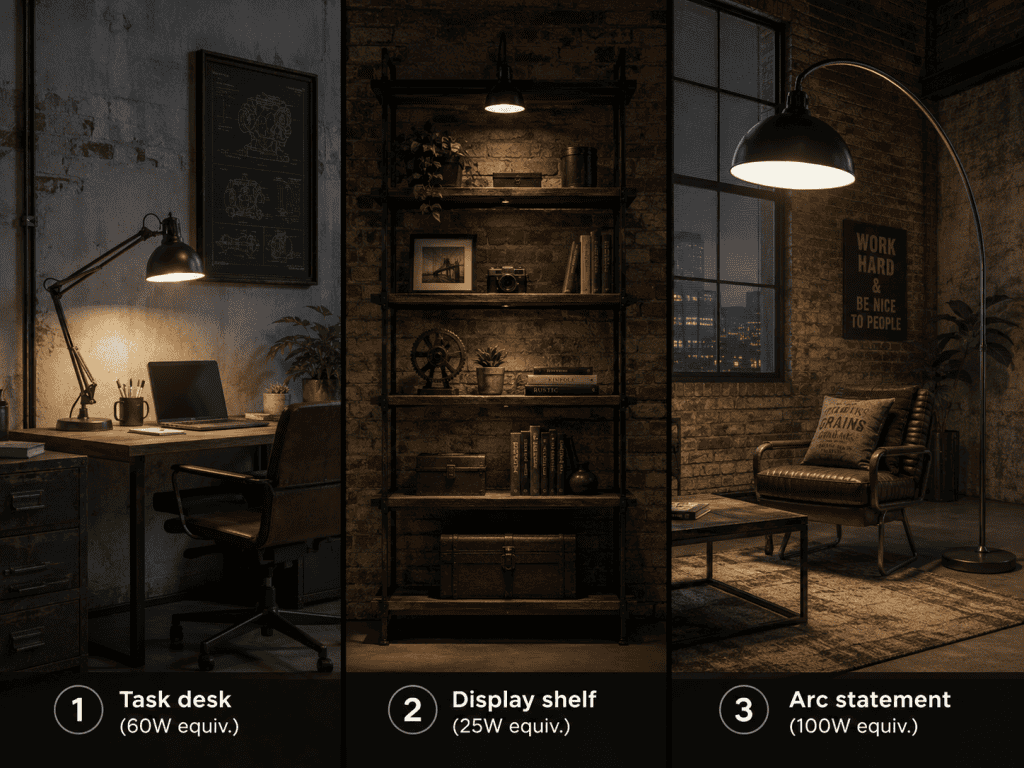
The Writing Desk – Task vs. Atmosphere Balance
This is probably the trickiest setup because writing desks need both focus and mood.
For most desks, a 40W–60W incandescent-equivalent LED filament bulb works best. That usually translates to roughly 450–800 lumens depending on bulb type.
Enough brightness for writing or keyboard work. Not enough to sterilize the room.
I personally prefer using:
one focused task lamp
plus a second low-output ambient source nearby
That layered approach feels far more cinematic than one aggressively bright desk lamp blasting the entire room.
And yes, LED-compatible dimmers help a LOT here.
Just make sure the bulb itself is labeled dimmable. Some LED filament bulbs dim beautifully; others flicker, buzz, or drop off too suddenly at low settings.
The Display Shelf – Accent Lighting at Low Output
Shelves are where low-output bulbs become magical.
A small 25W-equivalent Edison-style LED bulb tucked beside brass instruments, mechanical clocks, or old books creates incredible depth without overwhelming nearby objects.
This is also where candelabra-style LED filament bulbs work beautifully.
Those tiny exposed filaments feel almost like miniature gas lamps when mounted inside black pipe fixtures.
Not practical for reading obviously. But atmosphere-wise? Incredible.
The Statement Arc Lamp – High Output, Warm Tone
Sometimes you actually do need more brightness.
Large loft spaces, open studios, or rooms with 12-foot ceilings can absorb light very quickly. In those cases, higher-output bulbs are fine – as long as the warmth stays intact.
This is where warm high-lumen LED filament bulbs become useful.
You can hit 100W-equivalent brightness while still maintaining a 2200K–2400K amber tone.
That combination keeps the room dramatic instead of clinical.
The Edison Bulb Variable – Old Incandescent Feel vs. Modern LED Filament Behavior
This part gets overlooked constantly.
Two bulbs can share the same Kelvin rating and still feel completely different emotionally.
Traditional incandescent Edison bulbs produced light through actual heated tungsten filaments. That created soft dimming behavior, rich amber falloff, and a very specific kind of old-world glow.
LED filament bulbs imitate that effect surprisingly well now, but they still behave differently.
Especially when dimmed.
Old incandescent bulbs tended to fade smoothly into deeper amber tones. Some LED filament bulbs maintain brightness too aggressively before suddenly dropping near the bottom range.
Not always bad. Just different.
Here’s a rough conversion guide:
| Old Vintage Incandescent Reference | Modern LED Filament Equivalent |
| 25W Edison | 2–4W LED filament |
| 40W Edison | 4–6W LED filament |
| 60W Edison | 8–10W LED filament |
| 100W Edison | 14–17W LED filament |
Historically, real incandescent Edison bulbs had a slightly richer amber falloff, especially when dimmed.
But for modern U.S. homes, LED filament Edison bulbs are usually the smarter and more practical choice.
They keep the vintage look, run cooler, last longer, use less energy, and avoid the regulatory issues surrounding most general-purpose incandescent bulbs.
Just avoid ultra-cheap bulbs with fake orange coatings. Some of those look absolutely terrible in person.
A good LED filament bulb should look warm because of its color temperature and filament design – not because the glass has been painted pumpkin-orange.
Practical Recommendations by Product
Different lamp styles react differently to bulb wattage because of shade geometry, metal reflection, and bulb exposure.
For compact desk lamps with exposed pipe fittings, lower-output 40W-equivalent LED filament bulbs usually feel best, especially inside smaller apartments where excessive brightness can bounce aggressively off nearby walls.
Glass-shaded lamps behave differently. The shade softens the bulb, filters the brightness, and changes how the warmth spreads across the desk. For a real example of how shade design and wattage limits affect the final mood, see our VONLUCE rustic bronze desk lamp review.
Meanwhile, larger open-frame industrial fixtures can comfortably handle brighter LED filament bulbs without feeling overpowering.
Oneach-style exposed Edison lamps are a good example of this balance because the open geometry lets the filament become part of the visual experience rather than just a hidden light source.
Final Thoughts
Steampunk lighting was never about maximum brightness.
It was always about atmosphere.
About making brass glow softly against shadow. About letting iron disappear gradually into darkness instead of flooding every corner with sterile white light. About recreating the feeling of old machine rooms, underground laboratories, railway cabins, and forgotten libraries where technology still looked handcrafted.
That atmosphere depends on restraint.
Not power.
So before buying the brightest bulb possible, ask yourself something simpler:
What should the room feel like after midnight?
Because the answer usually lives somewhere around 2200K…
Inside an Edison-style LED filament bulb.
And with far fewer lumens than people expect.


