
Iron has never been a polite material.
It does not stay still. It does not keep its factory finish forever. It listens to the room, to the air, to the small amount of moisture that slips in after a shower, to the salt carried from coastal windows, to the quiet temperature swings near an HVAC vent.
Then it answers.
Sometimes that answer is beautiful.
A dark bloom across the metal. A soft black-gray patina in the corners. A surface that looks less manufactured and more inherited, as if the sconce spent twenty years above a workbench where someone sharpened tools under amber light.
But sometimes the answer is not patina.
Sometimes it is rust.
Orange. Powdery. Bubbling. Hungry.
The Steampunk paradox is that we love aged metal, but we do not want compromised metal. We want the romance of time, not the failure of neglect. An iron sconce should look like it survived a factory wall, not like it is slowly losing a war against bathroom humidity.
That is the line this guide is about.
Knowing what to preserve.
Knowing what to remove.
And knowing when the frame needs care before the damage reaches the socket, welds, or mounting points.
Before choosing a fixture worth maintaining long-term, start with the iron sconces worth protecting before rust ever becomes the story.
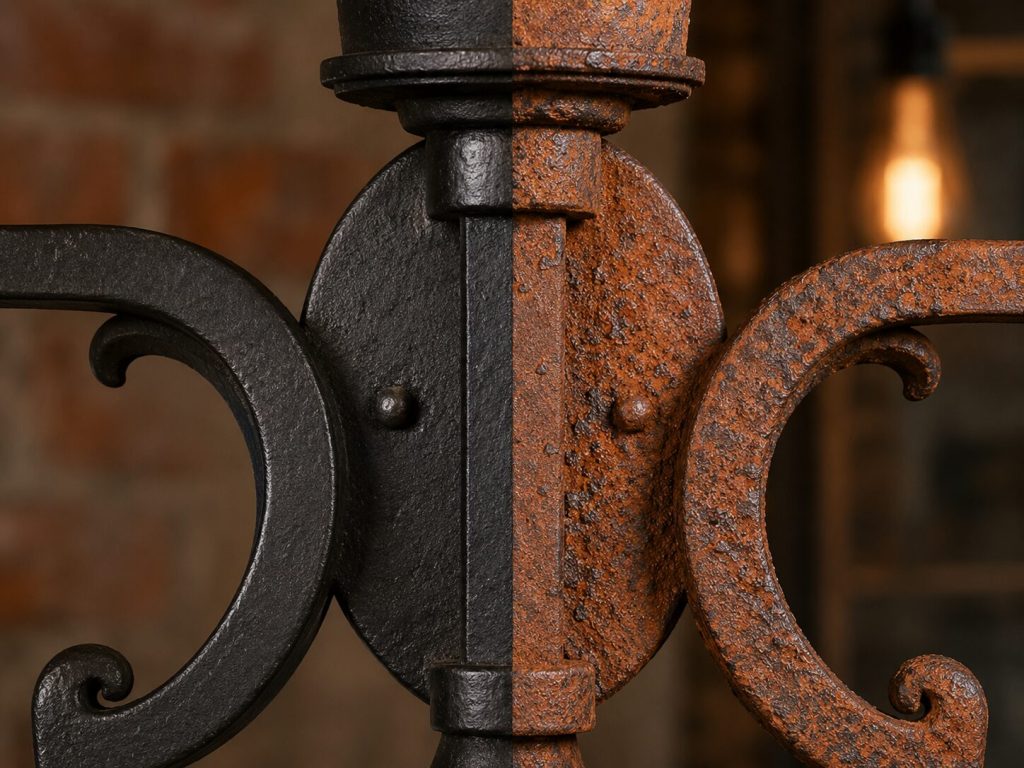
Iron and Air Are Old Enemies – Here’s How to Broker Peace
Iron rusts because it wants to return to the earth.
That sounds romantic, but the chemistry is simple. Iron reacts with oxygen in the presence of moisture. The result is iron oxide, the reddish-brown material we call rust.
Dry air slows the process.
Humid air accelerates it.
Salt accelerates it even more.
Heat cycling – warm, cool, warm again – encourages microscopic expansion and contraction that makes coatings fail sooner.
This is why an iron wall sconce in a dry study can age gracefully for years, while the same sconce near a bathroom door may begin showing orange freckles around welds in a few months.
Steampunk design lives in the tension between control and decay.
Too perfect, and the fixture feels fake.
Too neglected, and the fixture becomes unsafe.
The goal is not to make iron look new forever. That would defeat the material. The goal is to let iron age in the right direction: darker, deeper, more dimensional – not powdery, weak, or structurally compromised.
Understanding What You’re Dealing With
Iron deterioration does not happen all at once.
It moves in stages, and each stage asks for a different response.
Stage 1: Superficial Tarnish
This is the good kind.
The surface darkens into gray, black, or muted brown. It may look slightly cloudy under bright light. The texture remains smooth. Nothing flakes off when touched.
In a Steampunk room, Stage 1 is often desirable.
It gives the frame depth. It lowers the shine. It makes the fixture feel less like a product and more like a piece of equipment.
This is the finish you preserve, not attack.
Stage 2: Surface Rust
This is where intervention begins.
Surface rust appears orange-brown, often powdery, and usually starts at vulnerable points: seams, welds, screw heads, corners, pipe joints, cage intersections, and areas where the finish has been scratched.
At this stage, the rust has not yet deeply damaged the metal, but it is active.
If ignored, it continues.
This is the stage where gentle removal and immediate sealing matter most.
Stage 3: Deep Pitting Corrosion
This is no longer decorative.
The metal surface becomes uneven, cratered, or flaky. Small pits form. Edges may weaken. Around welds or socket areas, this becomes especially serious.
If corrosion appears near the electrical components of a sconce, treat the fixture as more than a cosmetic project. The metal frame may still look dramatic, but electricity does not care about atmosphere.
At Stage 3, restoration may be possible, but replacement or professional repair may be safer.
High-Risk Environments for Iron Sconces
Some rooms are harder on iron than others.
Bathrooms, kitchens, basements, coastal homes, covered porches, and entryways all create higher risk. Any space with humidity above 60% deserves more frequent inspection.
Bathrooms are the obvious enemy, but kitchens can be worse over time because cooking adds moisture, oils, and airborne residue. Coastal homes add salt, which makes oxidation more aggressive. Basements contribute dampness even when the air feels cool and still.
HVAC vents are another quiet problem. If warm and cool air repeatedly cycles across the same iron fixture, the finish expands and contracts subtly over time. Small cracks form. Moisture enters. Rust begins where the coating fails.
The Hefoklu brushed gold finish, for example, belongs more naturally in bedroom environments than damp or bathroom-adjacent zones.
For placement caution, read why one warm brushed-gold sconce belongs near the bed, not the steam.
Electrical safety also matters in humid rooms. If you are deciding between hardwired and plug-in sconces near moisture-prone areas, read the installation choice that matters most when moisture enters the room before committing.

Cleaning Protocol by Oxidation Stage
The right cleaning method depends on what kind of oxidation you are actually seeing.
Preserved patina and active rust should not be treated the same way.
Stage 1 Cleaning – Preservation Polish
Stage 1 does not need aggressive cleaning.
In fact, overcleaning can ruin the exact surface character you bought the fixture for.
Start dry.
Use a microfiber cloth or soft detailing brush to remove dust from the frame, cage joints, pipe elbows, and mounting plate. Avoid water unless absolutely necessary. Dust mixed with moisture becomes grime, and grime holds humidity against the metal.
After dusting, apply a very light mineral oil wipe.
The word “light” matters.
You are not dressing a salad. You are placing a nearly invisible barrier between iron and air.
Wipe on a thin coat, then buff until the surface no longer feels oily. The result should be a slight darkened sheen, not a greasy film.
For normal dry rooms, monthly dusting and occasional oil wiping is enough.
Matte black finishes need a slightly different touch. Powder-coated or painted black metal does not behave like raw iron, and harsh polishing can dull the surface.
For a practical reference, read what a black anti-rust sconce can teach you about low-maintenance industrial finishes.
Stage 2 Cleaning – Rust Removal Without Stripping Character
Stage 2 rust asks for a firmer hand.
The goal is to remove active orange rust without stripping away every trace of age.
For light rust spots, white vinegar and 0000-grade steel wool can work well. The steel wool must be ultra-fine. Anything harsher risks scratching through the finish and creating new rust points later.
Apply vinegar sparingly to the rusted area, not the entire frame. Let it sit briefly, then work gently with the steel wool following the direction of the metal or pipe. Wipe clean immediately.
Do not leave vinegar sitting on iron longer than necessary.
Acid removes rust, but it can also continue working against the metal if forgotten.
For more stubborn rust, Naval Jelly can be effective. Apply only to the affected area, follow the manufacturer’s dwell time carefully, then neutralize and clean completely. This is not a product to use casually across an entire decorative surface.
After cleaning, sealing is non-negotiable.
Bare freshly cleaned iron is vulnerable. The moment rust is removed, the exposed area needs wax, oil, or another protective barrier before moisture returns.
For companion material-care techniques, read the brass-and-iron cleaning philosophy that keeps patina without inviting damage.
Stage 3 Intervention – When Professional Help or Replacement Is Right
Stage 3 is where romance has to step aside.
If corrosion has created deep pits, flaking metal, or weakness near mounting points, the fixture deserves serious evaluation.
Electrolytic rust removal can save heavily rusted metal, but it usually requires removing the fixture, separating electrical components, and treating the metal safely away from wiring.
That is not a casual wall-cleaning afternoon.
If pitting appears near the socket, wire path, bracket weld, or mounting plate, replacement may be the wiser choice. An iron frame is part of the electrical fixture’s physical safety. If that frame loses integrity, the whole object becomes questionable.
There is no shame in retiring a damaged piece.
Even old machines eventually leave the workshop.

Sealing and Protection – The Work After the Work
Cleaning is only the visible part.
Protection is what keeps the rust from returning.
Wax-Based Sealants – The Low-Sheen Option
Paste wax is one of the most Steampunk-friendly finishes because it protects without making the iron look plastic.
Johnson’s Paste Wax or Renaissance Wax both work well for decorative metal. Apply a thin coat with a soft cloth, let it haze slightly, then buff before it fully hardens.
The result should be subtle.
Not glossy. Not slick.
Just sealed.
Wax works especially well for sconces in studies, bedrooms, hallways, and dry living rooms.
Oil-Based Sealants
Linseed oil has a long history in blacksmithing and tool care. It darkens iron beautifully and gives the metal a deeper, older appearance.
Use it carefully.
Thin coats only. Full drying time. Good ventilation.
Mineral oil is simpler, cleaner, and safer for fixtures near kitchens because it is food-safe and easy to refresh. It does not harden like linseed oil, so it needs reapplication more often, but it is forgiving.
Oil finishes feel right on Steampunk metal because they do not erase texture.
They deepen it.
Clear Lacquer – When and Why to Avoid It
Clear lacquer seems like the obvious solution.
Seal the iron. Lock out moisture. Done.
But lacquer can become a trap.
If any moisture remains beneath the coating, or if the lacquer later chips, rust can spread under the surface. Once that happens, the damage becomes harder to see and harder to stop.
Use clear lacquer only when the iron is completely dry, fully rust-free, and installed in a low-humidity environment.
For most Steampunk sconces, wax or oil feels more honest and more forgiving.
Baked varnish finishes behave differently from basic paint or lacquer.
For comparison, read why a baked copper finish resists oxidation longer than ordinary painted metal.
Maintenance Calendar for Iron Sconces
A good maintenance rhythm is quiet.
It should not feel like owning fragile antiques. It should feel like caring for tools.
Monthly: Dust with microfiber. Inspect visible welds, screw heads, pipe joints, and cage intersections.
Quarterly: Check for orange rust in high-humidity rooms. Reapply mineral oil lightly if the surface looks dry.
Every 6 months: Refresh wax or oil protection in normal rooms. For coastal or basement spaces, do this more often.
Annually: Remove bulbs, cut power if hardwired, and inspect around sockets and mounting plates. Look for corrosion near electrical components, not just on visible decorative surfaces.
After humidity events: If a room experiences leaks, condensation, or prolonged moisture, inspect immediately.
The purpose of this calendar is not perfection.
It is attention.
Iron rewards attention. It does not need fussing over every week. But ignored completely, it begins returning to dust.
A Steampunk room depends on materials that look as though they have endured time.
The secret is making sure they endure yours.
From lighting to shelving to small metal accents, long-term care becomes part of the room’s rhythm.For the bigger material-care picture, read the room-wide maintenance rhythm that keeps Steampunk materials aging beautifully instead of falling apart.


