
A fully realized Steampunk room does not announce itself with noise.
It glows.
Warm amber light pools beneath a cage lamp, catching the edge of brass fittings and the dark grain of a walnut desk. A gear clock turns slowly on the wall, not loudly, not theatrically – just enough to remind the room that time has a body. Black iron shelves hold books, instruments, maps, and small objects that look as if they were not bought last week, but inherited from someone who measured storms, repaired watches, charted coastlines, or built machines in a room full of smoke and patience.
This is the promise of Steampunk home decor.
Not nostalgia for the past exactly.
More like an alternate present – one where Victorian technology, craftsmanship, mechanical honesty, and industrial materials never disappeared behind plastic shells and invisible digital systems.
At its simplest, Steampunk interior design asks one question:
What if the future had been built by Victorian engineers?
The answer is a home filled with exposed mechanisms, brass instruments, iron hardware, dark wood, warm light, working clocks, functional objects, and rooms that feel less decorated than inhabited by someone with unusual seriousness.
This guide covers the complete system: the philosophy, room-by-room application, core product categories, material choices, build sequence, budget framework, sourcing strategy, and mistakes to avoid.

Steampunk Home Decor – What It Is, Where It Came From, Why It Endures
Steampunk home decor is an interior style inspired by the imagined continuation of Victorian-era technology, steam-age engineering, industrial craftsmanship, and retro-futurist invention.
It borrows from the world of Jules Verne, H.G. Wells, early factories, ship engine rooms, railway stations, laboratories, clockmaker benches, map rooms, and private studies lined with books and scientific instruments.
The term Steampunk was popularized in 1987, when writer K.W. Jeter used it to describe a literary movement responding to cyberpunk. But the visual language is much older. Its ancestors are found in Victorian engineering, 19th-century scientific culture, marine navigation, clockmaking, industrial hardware, and the belief that machines should be understandable by looking at them.
That last point is critical.
Modern technology is often invisible. A phone is a black rectangle. A smart speaker hides its mechanism. A laptop gives no clue how thought becomes signal, signal becomes light, and light becomes information.
Steampunk reacts against that invisibility.
It loves machines that show their work.
A clock reveals gears.
A lamp reveals its bulb.
A shelf reveals its brackets.
A barometer reveals measurement.
A pipe curtain rod reveals structure.
A pocket watch reveals time as a held object.
This is why the aesthetic endures. It offers more than decoration. It offers legibility.
In a world of sealed devices and hidden systems, Steampunk decor gives us objects that can be read by the eye and trusted by the hand.
The Five Core Principles of Steampunk Design
Every convincing Steampunk interior follows five principles.
You can apply them to a full Steampunk living room, a compact desk corner, an entryway, a bedroom, or a collector’s workshop. The scale changes. The philosophy does not.
Principle 1 – Exposed Mechanism
The central principle of Steampunk design is exposed mechanism.
The working parts of an object should be visible, suggested, or honored. This does not mean every object must literally move. It means the object should respect the logic of function.
A gear clock earns its place because timekeeping has visible form. A pipe shelf earns its place because the bracket is not hidden. A cage lamp earns its place because the bulb is exposed instead of disguised. A watch movement, pulley, barometer, industrial bracket, or black iron flange all speak the same language.
The historical basis is strong. In the Victorian industrial world, machinery was spectacle. People visited factories, exhibitions, railway stations, and engine rooms not only because these spaces produced goods, but because the mechanisms themselves were astonishing. The Great Exhibition of 1851 turned industrial machinery into public wonder.
In home decor, this becomes a test:
Does this object show how it works?
If yes, it has Steampunk credential.
If no, it may still look attractive, but it is aesthetic-only.
This principle applies at every scale. A visible Edison bulb matters. A pipe shelf bracket matters. A clock hand, switch plate, curtain rod, door knocker, and drawer pull all matter because they are the places where function becomes visible.
For the full room application of this principle, see see the steampunk living room guide – Principle 1 applied in full.
Principle 2 – Warm Metal Tones
The Steampunk metal palette is warm, aged, and mechanical.
The primary metals are:
brass
copper
aged bronze
black iron
wrought iron
dark steel
Each metal has a role.
Brass belongs to instruments, lamps, fittings, clocks, telescopes, switches, and precision details. It is the refined industrial metal.
Copper belongs to pipework, chemical apparatus, warm accents, and electrical imagination. It adds red-orange warmth and becomes richer as it ages.
Aged bronze belongs to sculpture, heavy decorative pieces, clocks, and objects that need depth.
Black iron belongs to structure: shelving, brackets, curtain rods, coat racks, flanges, and wall hardware.
Avoid:
chrome
brushed nickel
bright aluminum
mirror-polished silver finishes
These metals feel too contemporary, too sanitary, too post-Victorian. They belong more naturally to modern bathrooms, kitchens, and office interiors than to a Steampunk room.
The warm metal rule is simple:
Every visible metal should lean warm, dark, aged, or industrial.
Mixing metals is allowed, but it must be disciplined. Use one dominant metal, one accent metal, and one structural metal. Three is usually the maximum.
Example:
black iron for shelves and curtain rods
aged brass for clocks and instruments
copper for one or two accent objects
For a complete metal strategy, see our complete warm metal mixing guide.
Principle 3 – Repurposed Industrial Materials
Steampunk respects material honesty.
A real object made from real material is always stronger than a decorative object pretending to be industrial.
The hierarchy is:
genuine vintage industrial material
quality reproduction
decorative industrial aesthetic
A genuine salvaged cast iron bracket, brass gauge, old pulley, marine instrument, or reclaimed wood plank carries authority because it has already lived a functional life.
Quality reproduction is also valid when made with good materials and respect for historical form.
The weakest category is fake industrial: plastic painted “antique bronze,” hollow metal that pretends to be cast iron, chrome-plated zinc marketed as “vintage,” or MDF printed to look like wood.
Use the material honesty test:
Tap it. Does it ring like metal or thud like plastic?
Weigh it. Does it feel like its material?
Look at the edges. Is the finish surface-deep?
Check the screws, seams, and underside. Does the illusion survive contact?
One genuine antique industrial object per room can elevate everything around it. A salvaged iron hook, real brass barometer, or old wooden tool box makes newer reproduction pieces feel more believable.
For material history and sourcing, see authentic industrial materials – where they come from and what makes them real.
Principle 4 – Functional Ornamentation
Victorian design did not separate beauty from use as sharply as modern decor often does.
A good object should earn its display space.
The lamp lights.
The clock tells time.
The barometer measures pressure.
The shelf holds books.
The trinket box stores small items.
The hourglass measures an interval.
The telescope magnifies distance.
This is functional ornamentation: beauty earned by use.
A purely decorative object is not forbidden, but it should know its role. Small gear charms, sculpture, octopus objects, or figurines can work as accent pieces when they support a larger functional story. But a room full of decorative-only “Steampunk” objects quickly becomes shallow.
The strongest objects do two things at once.
An hourglass times and decorates.
A trinket box stores and decorates.
A telescope functions and displays.
A clock measures time and anchors the wall.
The forbidden category is not decoration itself. It is meaningless decoration: mass-produced objects with gear prints that do not function, reference nothing, and belong to no narrative.
For functional object categories, see our complete steampunk clock and instrument guide and our complete steampunk small decor guide.
Principle 5 – Narrative Layering
A Steampunk room should suggest a person.
Not just a buyer.
A person.
Whose room is this?
A navigator?
An inventor?
A scientist?
A clockmaker?
A telegraph operator?
A collector of natural history?
A Victorian engineer?
A cartographer?
Narrative is built through selection, grouping, scale, and repetition.
A navigator’s room uses maps, compass, telescope, armillary sphere, marine clock, and dark navy tones.
An engineer’s room uses gear clocks, technical drawings, pipe shelves, drafting tools, black iron, and oxblood leather.
A naturalist’s room uses specimen jars, botanical prints, barometer, magnifying glass, glassware, octopus sculpture, and forest green walls.
This comes directly from the Cabinet of Curiosities tradition. Victorian collectors built rooms that expressed their intellectual identity through curated objects. The room was a self-portrait in instruments, specimens, books, and artifacts.
The test:
A stranger enters the room. In five seconds, can they name the owner’s intellectual passion?
If yes, the narrative works.
For the deeper model, see the Victorian Cabinet of Curiosities – the narrative model for Steampunk decor.

Steampunk by Room – How the Aesthetic Adapts to Different Spaces
A good Steampunk home does not use the same formula in every room.
The grammar stays consistent. The vocabulary changes.
The Living Room – Social Steampunk
The Steampunk living room is public.
It receives guests, holds conversation, and displays the collector’s aesthetic openly. This is where the style can become dramatic without becoming theatrical.
Key decisions:
statement clock on feature wall
layered lighting with sconces
dark accent wall
leather seating
pipe shelving
curated display objects
heavy drapes
Essential elements:
gear clock or telephone clock
sconce pair
pipe shelving
dark wood or leather furniture
small instrument display
The mantle composition is the classic model: clock centered, sconces flanking, curated objects on the surface. If there is no mantle, create a visual mantle using a floating shelf, pipe shelf, or clock-centered gallery wall.
For the full application, see the complete steampunk living room and study guide.
The Study – Operational Steampunk
The Steampunk study is private and productive.
It should feel like a room where someone reads, writes, sketches, measures, thinks, repairs, or plans.
Key decisions:
desk lamp with proper task output
display shelving for books and instruments
usable desk surface
warm layered lighting
wall map or technical drawing
instrument triptych
Essential elements:
desk lamp
pipe shelving
small decor objects
barometer / thermometer / hygrometer
leather blotter
clock or timepiece
The desk should be curated, but not overcrowded. A study desk is not a museum shelf. It needs empty working space.
The Collector’s Workshop – Depth Steampunk
The Steampunk collector’s workshop is the most serious version of the aesthetic.
Its purpose is not only atmosphere. It demonstrates depth: instruments, categories, labels, collections, hardware, and a clear intellectual identity.
Essential elements:
clock
armillary sphere
instrument triptych
telescope
pocket watch
gear collection
heavy shelving
labeled objects
This room should feel inhabited by someone with expertise. The objects should be organized by theme, not scattered randomly.
For the complete build, see the complete steampunk collector’s workshop guide.
The Entryway – First Impression Steampunk
The Steampunk entryway announces the home before the visitor reaches the living room.
Key decisions:
door hardware
coat rack
sconce
mirror
first visible objects
threshold detail
Essential elements:
industrial coat rack
wall sconce
aged brass or black iron hardware
small curated accent objects
dark mirror frame
A good entryway does not need many objects. It needs strong hardware.
See steampunk entryway design – first impressions with hardware.
The Bedroom – Intimate Steampunk
The Steampunk bedroom should be quieter.
This is not the place for maximum density, too many gears, or theatrical display. The bedroom should use the aesthetic in a more intimate way: warm light, dark textiles, bedside objects, one strong statement piece, and careful restraint.
Key decisions:
bedside lamp
sconces flanking headboard
soft dark textile palette
minimal visible surfaces
one clock or instrument maximum
Best materials:
dark leather
velvet
aged brass
warm wood
black iron details
linen or heavy cotton
The bedroom should feel atmospheric, not staged.

The Six Essential Product Categories – What Every Steampunk Home Needs
This is the practical backbone of the entire home.
Most incomplete Steampunk rooms fail because they address only two or three categories. A complete room usually needs all six, even if some are small.
Category 1 – Desk Lamps
The Steampunk desk lamp is the task anchor.
It creates the personal relationship between occupant and light. This is especially important in a study, bedroom, reading corner, or workshop.
An authentic Steampunk lamp usually has:
pipe construction
cage design
Edison-compatible socket
brass or black iron finish
visible joints
warm output
2200K–2700K bulb temperature
Start with functional need first.
Do you need USB charging?
Touch dimming?
A large desk lamp?
A bedside lamp?
A reading lamp?
A decorative ambient lamp?
Then match the aesthetic.
See our complete steampunk desk lamp guide and rankings.
Category 2 – Wall Sconces
Wall sconces are the atmosphere layer.
They transform a room from merely lit to immersed.
A Steampunk sconce should have industrial heritage: cage, pipe, water pipe, brass plate, copper finish, or visible bulb logic.
Selection framework:
plug-in for renters
hardwired for permanent rooms
cage style for shadow play
copper or brass for warmth
black iron for structural severity
UL Listed when hardwired
Sconces are especially powerful beside bookshelves, flanking clocks, above entry coat racks, or beside the bed.
See our complete steampunk wall sconce guide and rankings.
Category 3 – Shelving
Steampunk shelving is the display architecture.
It is the stage on which clocks, books, instruments, small decor, and accessories perform.
Authentic shelving usually means:
iron pipe brackets
cast iron brackets
real wood boards
visible support
load-aware installation
dark finish
Avoid hidden floating shelves unless the room intentionally softens the industrial feel. Steampunk generally prefers visible support.
Selection framework:
wall type first
load requirement second
wood choice third
finish fourth
For serious collections, shelf strength matters. Books and instruments are heavier than they look.
See our complete steampunk shelving guide and rankings.
Category 4 – Clocks and Instruments
The Steampunk clock is often the room’s center of gravity.
It is the philosophical object: time made visible.
Authentic clocks and instruments can include:
moving gear clocks
telephone wall clocks
Nixie-style clocks
octopus clock sculpture
barometers
thermometers
hygrometers
marine chronometer references
Selection framework:
room size determines clock size
room character determines clock type
budget determines vintage vs. reproduction
sound tolerance determines ticking vs. silent sweep
A large living room can take a dramatic gear wall clock. A desk can take a Nixie clock. A naturalist shelf can take an octopus clock sculpture.
See our complete steampunk clock and instrument guide.
Category 5 – Small Decor
Steampunk small decor creates narrative texture.
These are the objects people examine up close: gear charms, hourglass, armillary sphere, trinket box, rotary phone ornament, specimen jars, compasses, small sculptures.
Good small decor should be:
functional or function-referential
made from honest materials
narratively coherent
properly scaled
grouped with negative space
Small decor should never become clutter. It should reward close inspection.
See our complete steampunk small decor guide.
Category 6 – Accessories and Hardware
Accessories and hardware create the commitment layer.
This includes:
curtain rods
coat racks
door knockers
pocket watches
goggles
telescope
top hats
custom artisan pieces
hardware details
This is where Etsy often outperforms mass retail. Steampunk benefits from customization, engraving, made-to-order work, and vintage sourcing.
Selection framework:
start with hardware before wearables
match all metal finishes
prioritize artisan or functional pieces
avoid costume-only objects unless intentionally displayed
See our complete steampunk accessories guide on Etsy.

The Materials Guide – What Steampunk Is Made Of
Materials are where the aesthetic either becomes believable or collapses.
Metals
| Metal | Steampunk Role | Care | Sources |
| Solid brass | Instruments, precision fittings, lamp fixtures | Polish or allow patina | Specialty hardware, antiques |
| Copper | Pipes, decorative elements, chemical apparatus | Polish indoors, allow verdigris outdoors | Hardware stores, salvage |
| Cast iron | Brackets, gates, hooks, structural pieces | Oil or wax to prevent rust | Architectural salvage, hardware |
| Wrought iron | Forged hooks, hangers, fire tools | Same as cast iron | Blacksmiths, salvage |
| Bronze / cold cast bronze | Sculpture, clocks, figurines | Dry brush, wax, gentle care | Artisan decor, Etsy |
| Black steel / iron pipe | Shelving, curtain rods, coat racks | Annual wax coat | Hardware stores |
Wood
| Wood | Steampunk Credential | Best Use | Finish |
| Reclaimed / scaffold plank | Highest – genuine industrial history | Heavy shelving, statement surfaces | Oil only |
| Walnut | High – Victorian furniture standard | Desk surface, shelf boards | Danish oil |
| Oak | High – period furniture and flooring | Shelves, desk, bookcases | Fumed or oil finish |
| Pine | Moderate – utilitarian workshop material | Budget shelving | Dark stain + oil |
| MDF | None | Avoid | N/A |
Textiles
Use:
dark leather
velvet
tweed
heavy wool
linen
canvas
dark cotton
Avoid:
polyester sheen
light synthetic fabrics
modern geometric prints
floral cottage patterns
thin curtains
pale upholstery
Textiles should support the room’s weight. A Steampunk room can use softness, but not flimsiness.
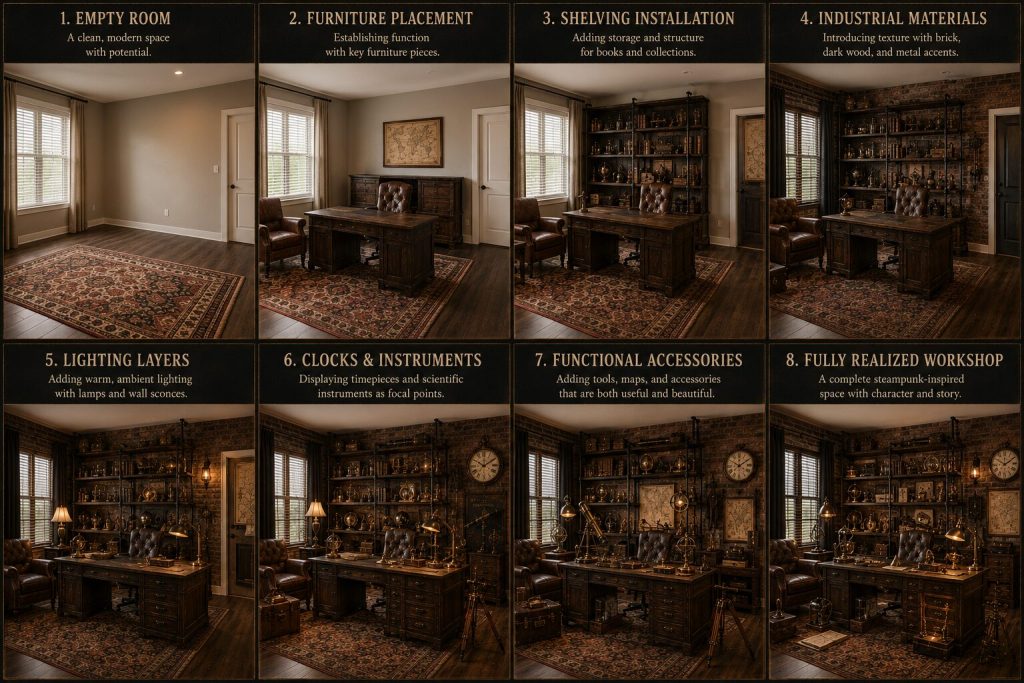
The Complete Build Guide – From Empty Room to Finished Atmosphere
Order matters.
Most rooms fail because the buyer starts with objects before building the stage.
Step 1 – Establish the Character
Before spending anything, write down the room’s identity.
Navigator?
Engineer?
Scientist?
Technologist?
Collector?
Clockmaker?
Naturalist?
This determines every selection that follows.
Step 2 – Wall Color
Paint is the cheapest per-square-foot transformation.
Use at least one deep feature wall:
forest green
charcoal
navy
burgundy
deep ochre
dark teal
Do this before furniture and objects. The wall is the atmosphere field.
Step 3 – Structural Hardware
Install shelving and curtain rods early.
Shelving defines display territory. Curtain rods define the window plane. These choices become difficult to change after objects are placed.
Step 4 – Lighting
Lighting sequence:
desk lamp
sconces
ambient support
Use 2200K–2700K throughout. This is non-negotiable.
For lighting strategy, see the art of layered lighting – combining desk lamp, sconce, and overhead.
Step 5 – The Anchor Object
Choose the anchor: usually a clock.
Place it in the most prominent wall position. The room should orient around it.
Step 6 – Instrument Layer
Add instruments appropriate to the room character:
barometer
compass
telescope
armillary sphere
hourglass
thermometer
hygrometer
For weather instruments, see how to read an aneroid barometer – and why Steampunk collectors love them.
Step 7 – Small Decor
Now fill shelves and desks.
Use books, gear charms, hourglass, trinket box, armillary sphere, specimen jars, maps, and small tools.
Fill only 40–60% of shelf space.
Step 8 – Accessories and Hardware Finishing
Add the final layer:
curtain styling
coat rack
door hardware
wearables on display
pocket watch stand
labels
small hardware details
This is where the room stops looking assembled and starts looking lived in.
Steampunk on a Budget vs. Investment Pieces – A Decision Framework
Steampunk can be affordable, expensive, or anything in between.
The mistake is spending randomly.
Start Here: Under $50 Total
Best low-cost changes:
gear charms
Edison bulb swap
dark wall paint
aged brass switch plate
small vintage frame
glass jar with mechanical parts
A single dark wall and a warm bulb can make existing objects look better immediately.
Build Here: The $200–500 Room Foundation
This is where the room becomes serious.
Prioritize:
desk lamp
single sconce
pipe shelf brackets
dark wood shelf board
hourglass
trinket box
gear charms
small brass object
curtain rod
Build structure before buying too many accents.
Invest Here: Pieces That Last
Investment pieces should anchor the room.
Strong candidates:
large moving gear clock
solid brass armillary sphere
artisan brass telescope
heavy-duty pipe shelving
quality leather chair
genuine antique industrial object
salvaged cast iron hardware
The rule:
One investment piece per room plus well-chosen budget objects.
The investment object makes the budget objects look intentional. Without it, the room may feel like a collection of inexpensive themed items.
Where to Buy Steampunk Decor – A Sourced Guide
Amazon
Best for:
desk lamps
wall sconces
pipe shelving
clocks
small decor
basic hardware
Advantages:
review volume
Prime shipping
30-day returns
customer photos
comparison shopping
Verify:
UL listing for hardwired lighting
exact dimensions
material claims
customer photo evidence
return policy
Etsy
Best for:
artisan hardware
engraved pieces
made-to-order objects
vintage accessories
custom pocket watches
brass telescopes
Steampunk goggles
unique lamps
Advantages:
direct maker communication
personalization
genuine vintage objects
small-batch craft
Verify:
seller rating
review count
shipping country
lead time
return policy
custom order restrictions
Architectural Salvage
Best for:
genuine Victorian hardware
cast iron brackets
old door hardware
factory hooks
antique instruments
industrial pulleys
reclaimed wood
Sources:
local salvage dealers
estate sales
demolition sales
specialist auctions
eBay specialty categories
Verify:
condition
mounting compatibility
rust level
missing parts
actual item photos
Specialty Hardware
Best for:
door hardware
switch plates
cabinet pulls
brass knobs
quality reproduction fittings
Good reproduction hardware can be better than poor antiques. Look for solid materials and clear specifications.
Frequently Asked Questions
Is Steampunk the same as industrial interior design?
No.
Industrial interior design is usually raw, minimal, contemporary, and factory-inspired.
Steampunk interior design is industrial plus Victorian specificity, narrative layering, warm metals, visible mechanism, and historical imagination.
Industrial decor uses factory materials for texture.
Steampunk uses those materials to tell a Victorian technological story.
Can Steampunk work in a small apartment?
Yes, but with more discipline.
A small apartment should use fewer, stronger objects.
Use one statement piece per room: clock, telescope, or lamp – not all three at once.
Small-space priority:
dark accent wall
warm lamp
one shelf
one clock or instrument
three-object vignette
hidden storage
For compact rooms, see steampunk decor for small spaces – the discipline guide.
How do I start if I’m completely new to Steampunk decor?
Start simple:
Paint one wall dark.
Replace one lamp with a warm Steampunk desk lamp.
Add gear charms or a small brass object.
Install one shelf.
Choose one clock.
Build slowly.
Then read the complete steampunk living room and study guide.
What’s the biggest mistake beginners make?
Starting with small objects before establishing surfaces, light, and structure.
Small objects on a white wall under cool light become clutter.
The same objects on dark wood, warm light, and iron shelving become a collection.
For a deeper mistake list, see five steampunk decor mistakes – and better alternatives.
Is Steampunk expensive?
It can be, but it does not have to be.
The range is wide: a few small accents may cost little, while quality clocks, artisan telescopes, salvaged hardware, or custom furniture can be major investments.
The best approach is to invest in structure and anchor pieces, then support them with affordable objects.
Quality Steampunk objects do not go out of fashion quickly because they are tied to materials and function, not trend color.

Your Complete Steampunk Decor Toolkit – All Resources
| What You Need | Where to Go |
| Desk lamp selection guide | → Best Steampunk Desk Lamps |
| Edison vs LED bulbs for Steampunk | → Edison vs LED Filament |
| Wall sconce guide | → Best Steampunk Wall Sconces |
| Layered lighting strategy | → Art of Layered Lighting |
| Pipe shelving guide | → Best Steampunk Shelves |
| Wood selection for shelves | → Wood Plank Selection |
| Clock selection guide | → Best Steampunk Clocks |
| Barometer guide | → How to Read Aneroid Barometer |
| Small decor curation | → Best Steampunk Small Decor |
| Vignette styling | → How to Curate a Steampunk Vignette |
| Accessories on Etsy | → Best Steampunk Accessories |
| Mixing metals guide | → Mixing Metals in Steampunk |
| Complete Living Room / Study | → The Steampunk Living Room & Study |
| Complete Collector’s Workshop | → The Steampunk Collector’s Workshop |
Final Thought: Steampunk Is Not a Theme – It Is a Standard
The weakest version of Steampunk home decor is a costume.
A few gears.
A fake bronze finish.
A printed clock face.
A lamp that looks old but works like nothing.
Objects chosen because the listing title said “Steampunk.”
The strongest version is a standard.
Materials should be honest.
Mechanisms should be visible.
Objects should function.
Metal should feel warm and aged.
Rooms should tell a story.
Collections should be curated, not accumulated.
A true Steampunk room does not feel like it was decorated in a weekend.
It feels assembled over time by someone who cares how things work.
That is why the style endures.
Not because brass is fashionable.
Not because gears are cool.
Not because Victorian nostalgia sells.
Because somewhere beneath the iron, wood, glass, leather, and amber light is a quiet belief:
Beauty means more when it has a job to do.