
Before the industrial shelf became iron pipe, black brackets, reclaimed planks, and wall-mounted display systems, it had a quieter ancestor.
A more polite one.
It stood in the corner of a Victorian parlor, usually tall and narrow, with three, four, sometimes five little tiers. Its uprights were turned wood, its shelves were thin, and its surface carried porcelain, small books, shells, clocks, dried specimens, travel souvenirs, framed miniatures, and whatever else the household believed deserved to be seen.
It was called the whatnot shelf.
The name sounds almost unserious now. “Whatnot” feels like a shrug, a miscellaneous thing, a drawer of leftovers. But in the Victorian home, the whatnot was not random. It was a visible autobiography. It told visitors what the household valued, where the family had traveled, what they read, what they collected, what they believed, and what kind of taste they wished to project.
A whatnot shelf was not storage.
It was social speech.
And if you look closely at a modern Steampunk shelf, with its brass instruments, old books, glass jars, dark wood, and iron supports, you can still see that Victorian ancestor standing behind it.
Only now, the mahogany has become pipe, the porcelain has become pressure gauges, and the parlor has become a study, workshop, or mechanical library. But the impulse is the same: to collect, to arrange, and to reveal the self through objects.
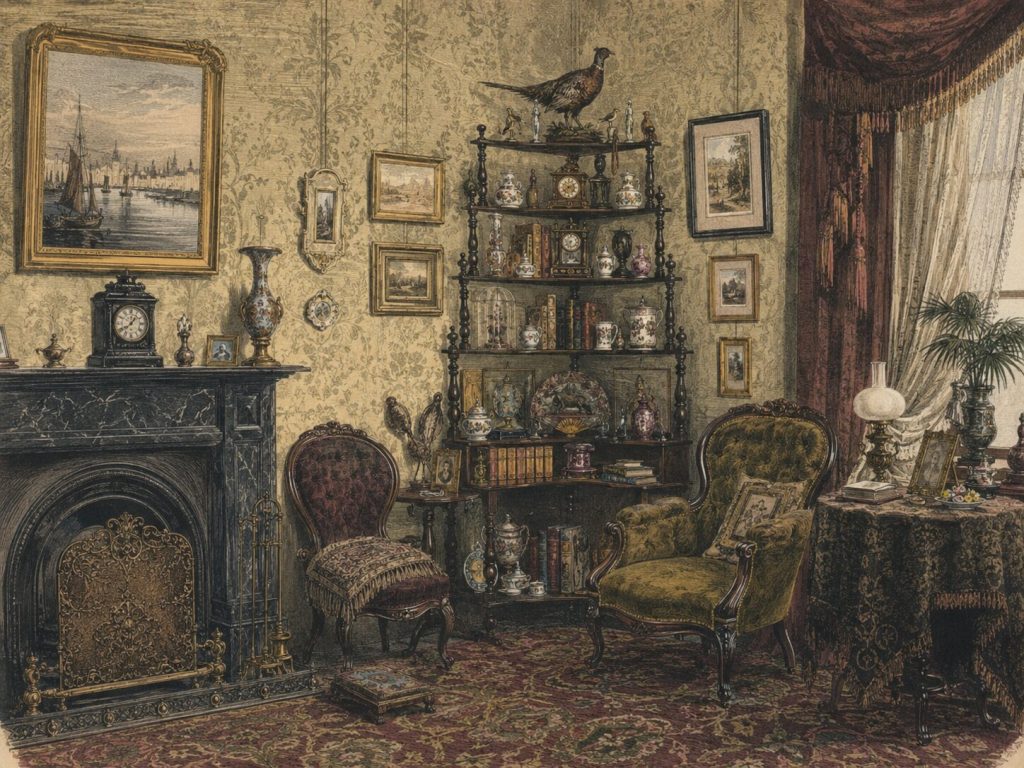
Before the Industrial Shelf, There Was the Whatnot – and It Was Everything
The whatnot shelf was one of the defining display objects of the 19th-century middle-class home. In French, a related form is often called an étagère. In German, one might think of the Wandregal, or wall shelf. But the English “whatnot” carries something more charmingly Victorian: the idea that the shelf exists for small collected things that resist strict category.
A porcelain figure from an aunt, a shell from a seaside holiday, a small framed photograph, a clock, a devotional object, a specimen, or a book too handsome to hide – the whatnot existed to hold the in-between objects of domestic identity.
From the 1830s through the Edwardian period, it appeared in many middle-class homes, especially in parlors and sitting rooms. Its job was not merely to organize possessions. Its job was to make possession visible.
That sounds familiar because modern Steampunk shelving does the same thing.
A Steampunk display unit does not simply hold decor. It creates a readable identity around tools, instruments, books, maps, gauges, clocks, and mechanical fragments. It tells the visitor that the person who lives here is curious about time, machinery, travel, science, invention, and old-world material beauty.
That is the whatnot spirit.
Only translated into iron.
The Whatnot’s Design Evolution
The Victorian whatnot did not stay the same for seventy years. It changed as Victorian taste changed. Early versions were refined and delicate, mid-century versions became more self-conscious and artistic, and late versions began absorbing heavier, more scientific, more masculine material language.
That last stage is where the path toward Steampunk shelving becomes clearest.
Early Whatnots, 1830s-1850s – Mahogany and Brass
Early whatnots were often built from mahogany, rosewood, or other polished domestic woods. They were light, vertical, and tiered, usually with three to five shelves. Turned wooden uprights gave them a delicate architectural rhythm, and many were designed for corner placement because corners were underused territory in the Victorian parlor.
The corner mattered.
It allowed the whatnot to stand like a small tower of taste without interrupting the main furniture arrangement. It was visible but not central, present but not vulgar.
Typical display contents included porcelain figures, small books, shells, natural specimens, miniature portraits, travel souvenirs, small clocks, and religious keepsakes.
The early whatnot was genteel. It did not yet carry the mechanical heaviness we associate with industrial interiors, but structurally, it already contained the essential idea of the modern display shelf: vertical support, horizontal tiers, and curated objects arranged for interpretation.
Mid-Victorian Whatnots, 1860s-1880s – Reform and Aestheticism
By the mid-Victorian period, the whatnot became more expressive.
The Aesthetic Movement began influencing domestic design. Japanese references appeared. Ebonized wood, gilded details, asymmetry, geometric forms, and more stylized ornament entered the home.
This is where the whatnot becomes more interesting for Steampunk eyes.
It begins to look less like polite furniture and more like a designed display machine. Some versions incorporated mirror backs. Others used asymmetrical tiers. Some added drawers. Some became visually stranger, more architectural, and more self-aware.
The influence of designers like Christopher Dresser helped push domestic objects toward stylized geometry and reform-minded design. Not Steampunk yet, of course, but closer to the visual world Steampunk would later love: dark surfaces, strong silhouettes, display logic, and ornament disciplined by structure.
This is the whatnot beginning to understand itself.
Not merely a shelf for little things, but a framework for visual identity.

Late Victorian / Edwardian Whatnots, 1890s-1910s – The Scientific Version
By the late Victorian and Edwardian years, middle-class domestic display began absorbing more scientific and technical objects. Barometers, clocks, meteorological instruments, scientific models, globes, and technical curiosities found their way into homes. The parlor was no longer only a place of porcelain and refinement. It could also show intellectual seriousness.
The whatnot adapted.
Shelves became stronger. Materials became heavier. Some designs incorporated more masculine details. Darker finishes and metal accents became more plausible. The display object began to move from sentimental keepsake toward instrument, specimen, and evidence.
This is the direct predecessor of the modern Steampunk display shelf.
The modern collector may use pipe brackets instead of turned wooden uprights, but the logic is unmistakably Victorian: objects arranged vertically, by meaning, for social and intellectual display.
For a product that echoes the late Victorian tiered structure in a modern form, read why the BIXIRAO adjustable 4-tier frame feels closest to the old Victorian tiered whatnot structure.
The Whatnot’s Social Function – Display as Communication
A whatnot shelf was not innocent.
It communicated.
In the Victorian home, the parlor was a public room inside a private house. Guests saw it, visitors read it, and the objects displayed there worked almost like social signals.
A shelf could say refinement, education, piety, travel, scientific curiosity, taste, family memory, or economic comfort.
This is why the arrangement mattered.
It was never just clutter.
What a Whatnot Said About Its Owner
Travel specimens suggested worldliness and access. A shell, carved object, foreign souvenir, or map fragment hinted that the family had either traveled or had connections to those who did.
Scientific instruments suggested intellectual seriousness. A barometer, small telescope, magnifier, or clock made the household appear curious, rational, and engaged with modern knowledge.
For modern Steampunk parallels, read the Steampunk clocks and gauges guide for scientific objects that still command a shelf today.
Religious objects suggested piety and propriety, anchoring the household in moral respectability. Porcelain suggested taste and refinement, and its delicacy implied care, class, and domestic polish.
The whatnot was a small stage where all of these identities could coexist.
And that is still how a Steampunk shelf works today.
A shelf with only gears says very little. A shelf with gears, books, a clock, a map, a glass specimen jar, and a brass instrument begins to feel like a mind with interests.
That difference is everything.
For the display principles that still apply today, read the Victorian curation logic that still keeps modern Steampunk shelves from becoming clutter.
The Cabinet of Curiosities as Whatnot’s Older Cousin
The whatnot had an older relative: the cabinet of curiosities, or Wunderkammer.
In the 16th and 17th centuries, collectors used cabinets and rooms to arrange natural specimens, scientific instruments, artworks, relics, shells, maps, fossils, and strange objects from across the known world.
The goal was not always scientific classification in the modern sense.
It was meaning-making.
The collector created a miniature universe.
The Victorian whatnot brought a smaller, domestic version of that impulse into the parlor. The Steampunk shelf revives it consciously.
That is why small objects matter so much in this style. A vial, a gear, a coin, a map, a compass, or a clock becomes a fragment of a larger imagined world.
For this older collecting tradition, read the cabinet of curiosities guide for understanding why small objects can make a room feel like a private universe.

From Whatnot to Industrial Shelf – The Continuity
The whatnot faded because the 20th century became suspicious of display. Modernism preferred clean lines, hidden storage, open surfaces, and fewer visible objects. What the Victorian home called identity, modern taste often called clutter.
The whatnot became old-fashioned, then embarrassing, then antique.
But it never fully disappeared.
It survived in antique shops, eccentric homes, collectors’ rooms, libraries, and the corners of people who still believed objects deserved to be seen.
What Was Lost in Modernism
The mid-20th century did not simply remove ornament. It changed the moral tone of interiors.
Open display became suspect. Too many objects suggested dust, sentimentality, excess, or lack of discipline. The clean modern home wanted surfaces to be empty, storage to be hidden, and objects to be reduced.
There were benefits to that shift, but something was lost.
The home became less readable.
Fewer objects meant fewer clues. Fewer collections meant fewer visible obsessions. Fewer shelves meant fewer small stories.
The whatnot represented a belief that objects matter because they carry memory, knowledge, and identity. Modernism did not destroy that belief; it pushed it underground.
The Steampunk Reclamation
Steampunk brings that belief back openly.
A Steampunk shelf says the room should be readable. It says objects are not automatically clutter. It says a visible collection can be intellectual, atmospheric, and deeply personal if arranged with intention.
The pipe bracket replaces the turned wooden upright. The dark plank replaces the polished parlor shelf. The brass compass replaces porcelain. The pressure gauge replaces the devotional miniature. The Edison lamp replaces the delicate figurine.
But the structure remains familiar: tiered display, curated meaning, identity made visible.
That is why Steampunk shelving is not merely industrial storage. It is Victorian display culture rebuilt with heavier materials.
For modern shelf systems carrying that tradition forward, read the Steampunk industrial shelf ranking for modern displays that still believe objects deserve to be seen.
Building a Modern Whatnot – How to Honor the Tradition Without Copying It
You do not need to buy an antique whatnot to honor the whatnot tradition. In fact, copying the original too literally can feel fragile or theatrical in a modern room.
The better approach is to preserve the principles.
Principle 1: Tier Variation
A whatnot works because objects rise through levels.
Use vertical spacing deliberately. Tall objects should have clearance. Smaller artifacts should sit on books or risers. A tiered shelf system can create the same upward rhythm as the Victorian original without using delicate turned wood.
Principle 2: Corner or Edge Placement
The classic whatnot often lived in corners, and modern Steampunk shelves can do the same. A corner shelf, tall tiered rack, or narrow vertical display unit can turn unused architecture into a collector’s station.
This works especially well in studies, reading corners, and beside leather chairs.
Principle 3: Narrative Curation
Do not fill the shelf by object type alone.
Build small scenes: navigator, scientist, engineer, timekeeper, adventurer, naturalist, or inventor.
The Victorian whatnot was not random, even when it looked abundant. Your modern version should be the same.
Modern Substitutions
Replace porcelain with brass instruments. Replace lace doilies with a leather blotter or dark cloth. Replace sentimental miniatures with mechanical artifacts. Replace delicate carved uprights with black iron pipe. Replace polished parlor softness with amber light and shadow.
A modern whatnot should not pretend to be 1880.
It should feel like 1880 found a machine shop and decided to stay.
For an accessible modern shelf system, read the OLDRAINBOW review for a complete 3-tier system that can become a modern Steampunk whatnot without custom sourcing.
Final Thoughts
The Victorian whatnot shelf may sound like a quaint antique form, but its idea is still powerful.
A shelf can reveal a person.
Not through biography, but through objects: what they keep, what they study, what they display, and what they consider worth dusting.
The Steampunk shelf is the whatnot’s iron descendant. It carries the same belief in visible curiosity, but gives it darker materials, stronger brackets, warmer light, and a more mechanical imagination.
That is why a good industrial display unit should never feel like mere storage. It should feel like a life made legible.
A room worth reading.
For the full-room version of this idea, read how the complete Steampunk living room can work like a modern whatnot – a room arranged to be read, not just seen.


