
The Installation Decision That Defines Your Commitment
Choosing between a hardwired sconce and a plug-in sconce sounds like a technical decision.
It isn’t.
At least not entirely.
It is really a decision about permanence.
A hardwired fixture says: this wall matters, this room matters, and I am building something meant to stay.
A plug-in sconce says something different: I want flexibility, reversibility, and the freedom to evolve the room without opening drywall.
Neither choice is automatically superior.
The mistake is pretending they communicate the same thing.
In Steampunk interiors, lighting is architecture. The fixture is not just providing illumination. It is declaring intent. A hardwired copper pipe sconce mounted directly into plaster feels like part of the building’s nervous system. A plug-in cage sconce with a visible cord feels more temporary, more workshop-like, and more improvisational.
Both can work beautifully.
But they create different emotional registers.
This guide exists to help you choose correctly before drilling holes, hiring electricians, routing cords, or committing to a fixture that belongs to a different kind of room than the one you are actually building.

The Hardwired Sconce – Built for Permanence
A hardwired wall sconce is the serious version of wall lighting.
It asks more from the room.
But it also gives more back.
What Hardwiring Actually Involves
A hardwired sconce connects directly into the home’s electrical system through a junction box hidden behind the wall plate.
The logic is straightforward: power leaves the breaker panel, travels through the wall wiring, passes through a switch, arrives at the sconce junction box, and powers the fixture.
If your wall already has a junction box in the right location, installation becomes dramatically easier.
If it does not, an electrician may need to open drywall, run new wiring, install a junction box, then patch and repaint the wall afterward.
That is the real dividing line between “simple fixture install” and “small renovation.”
In the United States, most new hardwired fixture work should be handled by a licensed electrician unless you are very comfortable with electrical code, grounding requirements, and local permitting rules.
A bad plug-in lamp is annoying.
A bad hardwired installation can become a fire risk inside the wall itself.
The Aesthetic Advantage of Hardwired
Hardwired sconces create the cleanest possible wall.
No visible cord. No dangling line to an outlet. No visual interruption between fixture and architecture.
That matters more in Steampunk spaces than people realize.
Steampunk walls already carry visual complexity: aged plaster, brick texture, maps, brass hardware, shadow patterns, and framed patent drawings. Removing the cord keeps the wall from feeling over-explained.
The other major advantage is switch integration.
Hardwired sconces can use standard wall switches, dimmer switches, smart switches, dual-location hallway switches, and pull-chain fixtures in some designs.
The lighting starts feeling integrated into the building itself rather than attached afterward.
For a hardwired product example, read the Licperron – our top-rated hardwired sconce and how its metal mounting plate simplifies installation.
The Real Costs
The romantic fantasy of hardwired lighting usually ignores the electrician invoice.
If a junction box already exists, installation is relatively manageable. The electrician mostly mounts the fixture and connects wiring.
If there is no existing box, costs rise quickly because labor becomes wall work, not just fixture work.
That is why many people discover something uncomfortable: the fixture itself may not be the expensive part.
The wall preparation is.
And yet, once installed correctly, hardwired sconces become part of the room in a way plug-in fixtures rarely do.
They stop feeling like decor.
They start feeling structural.
For a pipe-style hardwired example, read the MQ 2-light copper – what hardwired installation looks like for a pipe-style sconce.

The Plug-In Sconce – The Intelligent Compromise
Plug-in sconces exist because real life exists.
Not everyone owns their home.
Not every wall has a junction box.
Not every room deserves electrical surgery.
Who Should Choose Plug-In
Plug-in sconces make the most sense for renters, apartment dwellers, frequent movers, people testing layouts before permanent installation, older homes without convenient wiring, temporary decor phases, and budget-conscious room upgrades.
The important thing is this: plug-in is not automatically inferior.
A thoughtfully installed plug-in wall sconce can look intentional, theatrical, and beautifully Steampunk.
It just requires more design discipline.
For renter-friendly planning, read our complete renter’s guide to steampunk sconce installation.
Cord Management – Turning a Liability Into a Feature
Most people fail with plug-in sconces because they treat the cord like an accident.
In Steampunk interiors, the cord can become part of the language.
Braided cloth cords work especially well in black, copper, bronze, dark brown, and aged ivory.
Routing strategies matter enormously.
The best options are along baseboard molding, behind furniture, inside decorative conduit, through copper pipe sections, or inside black iron pipe channels.
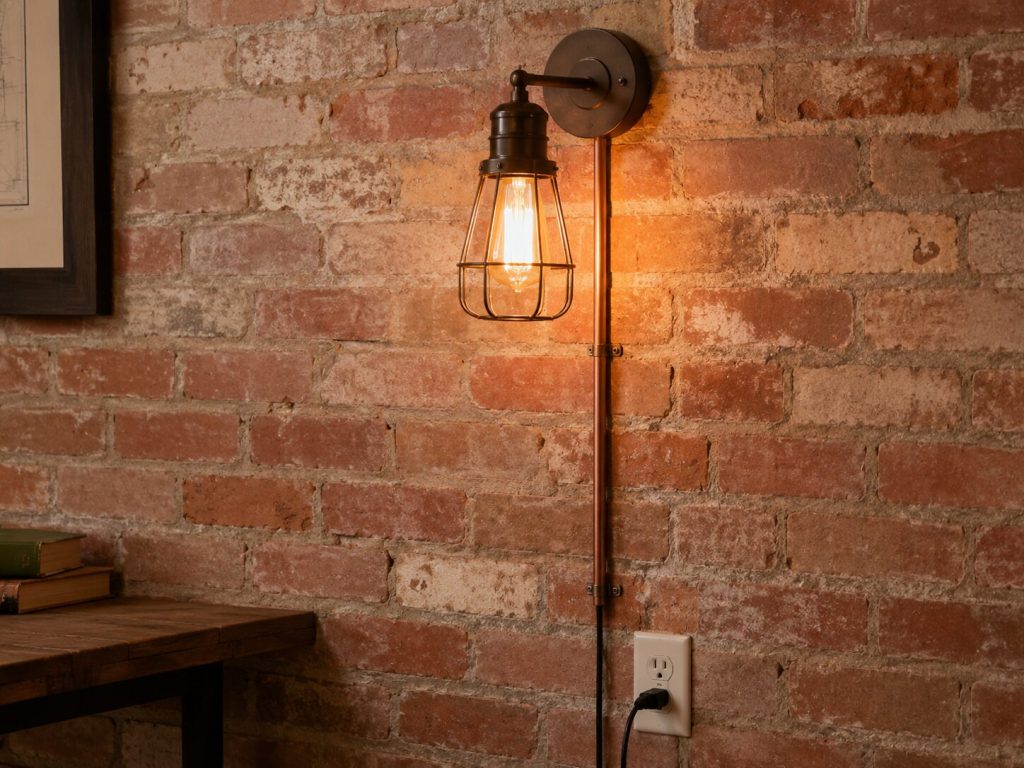
Copper pipe cord routing is particularly effective because it reframes the cord as “mechanical infrastructure” instead of visual clutter.
The wall stops apologizing for the cable.
It starts incorporating it.
For a real plug-in example, read the Lovefindahome cage sconce – 5.9ft adjustable cord and how to route it.
The Visual Limitation – Honest Assessment
Even with excellent routing, the cord usually remains at least somewhat visible.
That is the trade.
Some spaces embrace this naturally: workshop aesthetics, industrial lofts, exposed brick interiors, garage-office hybrids, maker spaces, and Victorian laboratory-inspired rooms.
Other spaces fight against it: formal hallways, minimal plaster corridors, high-end dining rooms, and symmetrical gallery walls.
The question is not whether visible cords are “bad.”
The question is whether the room accepts them honestly.
A visible cord in the wrong room feels temporary.
A visible cord in the right room feels mechanical.
That distinction changes everything.
For a bedroom-friendly plug-in example, read the Hefoklu brushed gold 2-pack – the one plug-in sconce with an inline cord switch.
The Middle Path – Plug-In With Concealment
There is a middle category many people overlook: plug-in sconces that hide the cord without becoming truly hardwired.
This approach works especially well for renters who want a cleaner wall but cannot open drywall.
In-Wall Cord Concealment Kits
Brands like Wiremold, Legrand, and D-Line make paintable surface raceways that hide cords without opening walls. These systems mount externally but visually disappear once painted.
For Steampunk spaces, profile choice matters.
Rounded white plastic channels usually look terrible.
Better choices include low-profile paintable raceways, dark metal-finish channels, channels hidden beside trim molding, or conduit aligned with architectural lines.
A concealment system should disappear into the wall rhythm rather than call attention to itself.
The Canopy Adapter Method
Some plug-in sconces use decorative wall canopies that visually imitate hardwired fixtures.
The cord exits discreetly from the side or bottom while the wall plate creates the illusion of permanent installation.
This approach works surprisingly well in reading corners, bedside installations, gallery walls, and single-feature accent walls.
It is not fully convincing at close inspection.
But from normal viewing distance, the room reads as cleaner and more integrated.
The trick is consistency.
If one fixture is obviously plug-in while another pretends to be hardwired, the room feels confused.
Choose a visual language and commit to it.
Decision Matrix and Product Matching
The easiest way to choose between hardwired vs. plug-in sconces is to answer a few practical questions before falling in love with a fixture photo.
Question 1 – Do You Rent or Own?
Renting usually points toward plug-in sconces.
Owning makes hardwired sconces more attractive, especially if the room is already part of a long-term design plan.
Question 2 – Is There Already a Junction Box?
An existing box makes hardwired installation practical.
No box makes plug-in dramatically easier.
Question 3 – Is Renovation Budget Available?
No renovation budget usually means plug-in.
If renovation is already happening, hardwired becomes much easier to justify.
Question 4 – Is Visual Perfection the Priority?
If you want an absolutely clean-wall aesthetic, hardwired wins.
If flexibility and adaptability matter more, plug-in wins.
Matching Installation Type to the Right Product
Once you choose the installation type, choosing the right Steampunk wall sconce becomes much easier.
Best Hardwired Choices
Licperron
Excellent for hallway symmetry, wall-hugging profile, and easy junction-box compatibility.
MQ 2-Light Copper
Best authentic pipe aesthetic for medium walls.
MQ 3-Light Copper
Statement installation for fireplaces, gallery walls, and long hallways.
For the large hardwired option, read the MQ 3-light – hardwired installation for a 45cm statement fixture.
Best Plug-In Choices
Lovefindahome Cage Sconce
Strong shadow drama, renter-friendly installation, and visible cord behavior that works naturally with industrial styling.
Hefoklu Brushed Gold Pair
Bedroom-focused, inline cord switch, and softer Victorian atmosphere.
Final Thoughts
The hardwired vs. plug-in decision is not really about electricity.
It is about how permanent you want the room to feel.
Hardwired sconces integrate the lighting into the architecture itself. They create cleaner walls, stronger permanence, and deeper visual commitment.
Plug-in sconces offer freedom. They evolve with the room. They respect renters, changing layouts, and experimental spaces.
Steampunk interiors can succeed with either approach.
What matters is honesty.
A hardwired fixture should feel structural.
A plug-in fixture should route its cord intentionally.
Neither should pretend to be something it is not.
Choose the installation type first.
Then choose the fixture that belongs to that kind of room.
For product selection after choosing your installation style, read choose your installation type – then choose your sconce from our top five picks.


