
A cabinet of curiosities begins with a simple belief:
The world is worth knowing.
Not decorating.
Not consuming.
Knowing.
A shell is not just a shell. It is evidence of a sea.
A fossil is not just a stone. It is time made holdable.
A compass is not just brass and glass. It is a promise that direction can be found.
A gear is not just a shape. It is proof that motion can be translated into meaning.
This is why the cabinet of curiosities belongs so naturally to Steampunk decor. Steampunk is not only an aesthetic of gears, brass, dark wood, and Victorian machinery. At its best, it is an aesthetic of deliberate collection.
A room full of objects is clutter.
A room full of chosen evidence is a cabinet.
The Room Where Everything Was Possible – Origins of the Cabinet of Curiosities
Before the modern museum, there was the Wunderkammer.
The German word means “wonder chamber.” In 16th- and 17th-century Europe, wealthy collectors, scholars, nobles, physicians, and travelers filled rooms or cabinets with rare objects from across the known world.
These early collections often mixed categories that modern museums would separate.
There were natural specimens: shells, fossils, coral, taxidermy, dried plants, bones, crystals.
There were man-made objects: automata, scientific instruments, artworks, coins, carved figures, mechanical devices.
There were geographical rarities: objects brought from the New World, Asia, Africa, and distant trade routes, often interpreted through the collector’s limited and sometimes distorted worldview.
The point was not just ownership.
The point was demonstration.
A cabinet of curiosities said: I have seen, acquired, studied, and arranged fragments of the world. I possess access. I possess taste. I possess knowledge.
At their best, these collections were acts of curiosity. At their worst, they reflected colonial extraction and the power imbalances of empire. Both truths matter.
But the philosophical claim remains important for modern Steampunk:
This room contains evidence that the world is worth studying.
That is the origin of the modern Steampunk collection. Not a pile of props. A miniature museum of fascination.
The Victorian Transformation – From Wunderkammer to Scientific Cabinet
Classification Becomes Central
By the 19th century, collecting had changed.
The older Wunderkammer loved wonder, but often mixed categories freely. The Victorian era wanted order. Science, empire, industry, and public education pushed collecting toward classification.
The rise of natural history museums institutionalized the cabinet. Objects were labeled, grouped, cataloged, and placed into systems.
A shell was not merely beautiful. It had a species name.
A fossil was not merely strange. It belonged to a geological period.
A crystal was not just luminous. It had structure, hardness, origin.
A barometer was not decorative. It measured air pressure.
The private Victorian collector followed this shift. Personal collections still existed in homes, studies, parlors, and libraries, but they increasingly borrowed scientific language.
Geological specimens were arranged by type: rock, mineral, crystal, fossil.
Ethnographic objects appeared as coins, textiles, tools, and carved items brought through travel, trade, or empire.
Mechanical instruments joined natural specimens: barometers, compasses, sextants, hygrometers, thermometers, chronometers, and astronomical models.
This is where the modern Steampunk cabinet finds its structure.
It does not simply collect “cool old things.” It creates categories: natural, mechanical, scientific, geographical, astronomical, industrial.
For contemporary clock and instrument display, see our steampunk clocks and instruments – the contemporary equivalent of Victorian scientific display.
The Social Function of the Victorian Collection
A Victorian collection was social.
Visitors were meant to look. The owner was meant to explain. Display was education, but it was also autobiography.
What you collected said who you were.
A shelf of scientific instruments suggested discipline and rational seriousness.
A cabinet of shells and pressed flowers suggested naturalist sensitivity.
A collection of coins and maps suggested travel, empire, history, and geography.
A set of mechanical models suggested industrial intelligence.
Collecting was not neutral.
It was identity arranged in objects.
There were also gendered patterns in Victorian collecting. Men were often associated with outdoor collecting: geological specimens, scientific instruments, tools, travel objects. Women were often associated with domestic or indoor collecting: shells, pressed botanicals, printed ephemera, embroidery, albums, keepsakes.
But both practiced deliberate accumulation. Both made meaning through arrangement.
That is the important inheritance for Steampunk collecting culture.
The act is not “owning many things.”
The act is choosing, naming, arranging, and explaining.
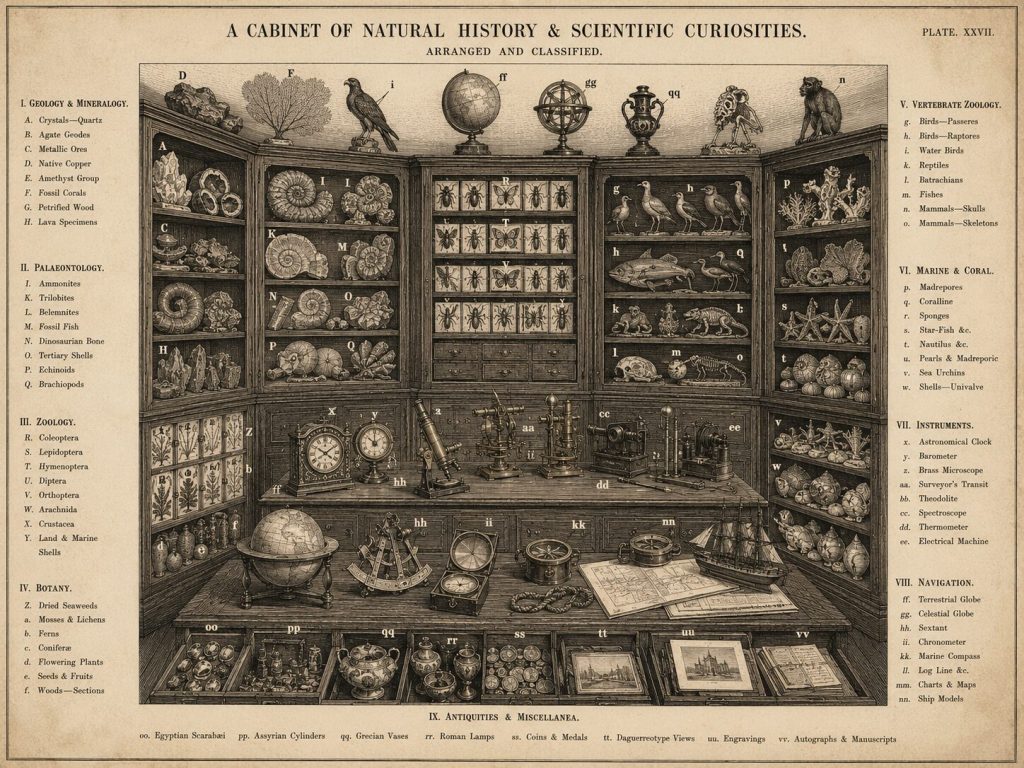
The Elements of a Modern Steampunk Cabinet
Natural Specimens
A modern Steampunk cabinet of curiosities should not be purely mechanical.
If everything is gear, pipe, clock, and brass, the display becomes dry. Victorian collecting always included the natural world.
Use shells, fossils, crystal specimens, pressed botanicals, seed pods, dried flowers, small stones, bones or ethical replicas, and insect specimens if sourced responsibly.
Display them in glass domes, specimen jars, wooden boxes, shallow trays, or small drawer cabinets.
Labels matter.
A small handwritten card changes a shell from “decor” into “specimen.” It does not have to be scientifically perfect, but it should feel considered: object name, origin if known, date acquired, short note.
The label is part of the object’s meaning.
Scientific Instruments
Scientific instruments are the backbone of the modern Steampunk cabinet.
A barometer does real work.
A compass suggests orientation.
A hygrometer measures humidity.
A thermometer reads the room.
A sextant and astrolabe evoke navigation and celestial calculation.
An armillary sphere models the heavens in miniature.
Functional instruments are strongest because they keep the Victorian principle alive: beauty should serve knowledge.
Decorative models can still work, but they should be honest. A non-functional armillary sphere is acceptable because its function is educational and symbolic. It shows the cosmos as structure.
For a modern example, see the Humaira armillary sphere – a nautical instrument model for a modern cabinet.
Mechanical Objects
A Steampunk cabinet needs mechanical evidence.
This can include pocket watch movements, clock parts, gear trains, springs, old keys, drafting tools, calipers, measuring devices, valves, small gauges, and machine fragments.
The best presentation is not random scattering.
Place mechanical objects in trays, jars, labeled boxes, or under glass. A small collection of gears in a jar reads as “parts archive.” The same gears thrown across a shelf read as mess.
For small mechanical fragments, see steampunk gear charms – the modern equivalent of a mechanical parts collection.
A pocket watch movement under a glass dome is especially powerful. It turns timekeeping into specimen display.
That is pure Steampunk: mechanism treated like natural history.
Geographical and Cultural Objects
A proper cabinet also needs evidence of place.
Use antique map prints, nautical charts, foreign coins, stamps, travel labels, postcards, small carved objects, replica expedition tags, and journals.
This category must be handled thoughtfully. Victorian collections often reflected colonial collecting practices, and modern displays should avoid treating cultural objects as exotic trophies.
The better approach is personal context: places you have been, places you study, maps tied to real interest, coins or stamps displayed with notes rather than mystery.
A map without context is decoration.
A map with a label becomes intellectual geography.

The Practice of Modern Curation – Becoming a Deliberate Collector
The Acquisition Principle
A true collection grows by reason, not impulse.
Before buying or placing any object, ask:
Why is this here?
That question saves the entire display.
A brass compass belongs if the shelf tells a navigation story.
A gear charm jar belongs if the shelf has a mechanical archive theme.
A fossil belongs if natural history is part of the cabinet.
A random octopus, gear, skull, and clock placed together may look Steampunk at first glance, but if they cannot explain each other, they become noise.
Victorian collectors acquired objects for scientific, cultural, personal, or symbolic significance. A modern Steampunk collector can do the same.
Each object should answer at least one of these:
It measures something.
It records something.
It represents a field of knowledge.
It has material authenticity.
It connects to a story.
It supports the cabinet’s taxonomy.
If it answers none, it may not belong.
The Label Practice
Labels are underrated.
A label changes how both viewer and collector relate to an object. It forces articulation. It asks you to name what the thing is, where it came from, and why it matters.
A good label can be simple:
Brass Compass – modern reproduction, acquired 2026 – navigation cluster
Quartz specimen – local mineral shop – natural history shelf
Gear fragments – decorative alloy charms – mechanical parts study
Pressed fern – collected from garden path – botanical drawer
Use small cards, cream paper, sepia ink, handwritten script, or typewriter-style text.
The label adds visual texture, but more importantly, it adds intellectual structure.
For more on intentional object labeling and arrangement, see vignette curation with intentional labeling – the full display guide.
The Rotation Practice
A serious collection should not all be visible at once.
This feels counterintuitive, but it is essential.
If every object is displayed permanently, the eye stops seeing them. The shelf becomes background. The collector becomes numb to the collection.
Victorian collectors rotated displays. Modern collectors should too.
Store 60–70% of the collection.
Display 30–40%.
Rotate monthly, seasonally, or by theme.
A winter cabinet might emphasize brass instruments, dark wood, clocks, and candles.
A spring cabinet might emphasize pressed botanicals, glass jars, maps, and natural specimens.
A “navigator month” might feature compass, armillary sphere, map, sextant, and ship bell.
A “mechanism month” might feature watch parts, gear charms, technical drawings, and clock fragments.
Rotation keeps attention alive.
It also gives every object the respect of being seen properly.
How to Build a Steampunk Cabinet From Scratch
Start with one category.
Do not begin by buying everything.
Choose one theme:
Natural history
Navigation
Clockwork
Scientific instruments
Industrial fragments
Maps and travel
Victorian desk objects
Then build slowly.
For a first cabinet shelf, use this structure:
one anchor object
two supporting objects
one label group
one small texture object
negative space around the group
Example: navigation shelf.
Anchor: armillary sphere
Support: small compass, rolled map
Texture: three gear charms or a coin
Label: handwritten card explaining the theme
Surface: dark wood shelf or leather mat
That is enough.
Do not rush into density. Density should be earned through taxonomy, not shopping.
Final Thought: The Cabinet Is a Way of Thinking
The cabinet of curiosities survives because it offers something modern rooms often lack: evidence of curiosity.
Not just taste.
Curiosity.
A good cabinet says someone has been looking closely. Someone has been collecting with purpose. Someone believes that objects can carry knowledge when arranged with care.
That is why Victorian collecting culture and Steampunk decor fit so naturally together.
Both love the visible mechanism.
Both respect instruments.
Both trust labels.
Both understand that small things can imply enormous worlds.
A shell can imply an ocean.
A gear can imply a machine.
A compass can imply a journey.
A fossil can imply deep time.
A clock can imply mortality.
A cabinet can imply a mind.
The best Steampunk cabinet is not the one with the most objects.
It is the one where every object feels like it was waiting to be asked the right question.
For building a full room worthy of this tradition, see the complete steampunk workshop – a room worthy of the cabinet of curiosities tradition.


