
Affiliate Disclosure: Some links in this article may be affiliate links from Amazon and Etsy. When you buy through them, The Mechanical Art may receive a small commission at no extra cost to you. Every product we mention is selected to match the industrial, mechanical, and steampunk-inspired spaces we love to explore.
A Steampunk desk can survive without another gear.
It can survive without another faux-rust box, another tiny key, another “vintage” object whose only argument is color.
But place a brass armillary sphere on the shelf, and the room changes register.
Suddenly, the story is not only industrial. It becomes astronomical. Nautical. Scholarly. A little more dangerous, because now the room suggests someone once looked at the sky and tried to turn it into metal.
That is why the Humaira Nautical Brass Armillary Sphere matters.
It is small. Much smaller than some buyers expect. But it carries something most small decor cannot fake: solid brass, a lacquered wooden base, and a form that reaches back through ancient astronomy, Renaissance navigation, Victorian scientific display, and modern Steampunk nautical desk decor.
For the full category context, see our complete steampunk small decor ranking.
The Only Solid Brass Object in This Guide – Why That Matters
In this small decor cluster, most products are useful because they create atmosphere.
The gear charms bring texture.
The hourglass brings function.
The trinket box brings storage.
The rotary phone ornament brings narrative.
The Humaira Armillary Sphere brings material credibility.
That is the difference.
In a group of resin, acrylic, zinc alloy, and plated decorative objects, this is the one object that stands apart as solid brass. Not brass-colored. Not brass-painted. Not merely “bronze look.” Solid brass.
That matters because solid brass behaves differently from surface finishes.
It has weight.
It has a clearer sound when tapped.
It can age naturally.
It can be polished.
It can develop real patina.
It feels less like decor and more like an instrument retired into display.
The review count is lower than the other products in the group – around 158 reviews – but that should be read carefully. This is not a commodity pack like 30pcs Steampunk Gear Charms. It is a compact collector’s object. Fewer people buy it casually.
The central argument of this brass armillary sphere review is simple:
Buy the Humaira Armillary Sphere when you want the most historically authentic, materially honest object in your Steampunk small decor collection.
Not the biggest.
Not the most functional.
The most honest.

See Brass Armillary Sphere on Amazon – Humaira Nautical Brass Armillary Sphere
What an Armillary Sphere Is – Historical Context
Origins – Ancient Greece to Renaissance Navigation
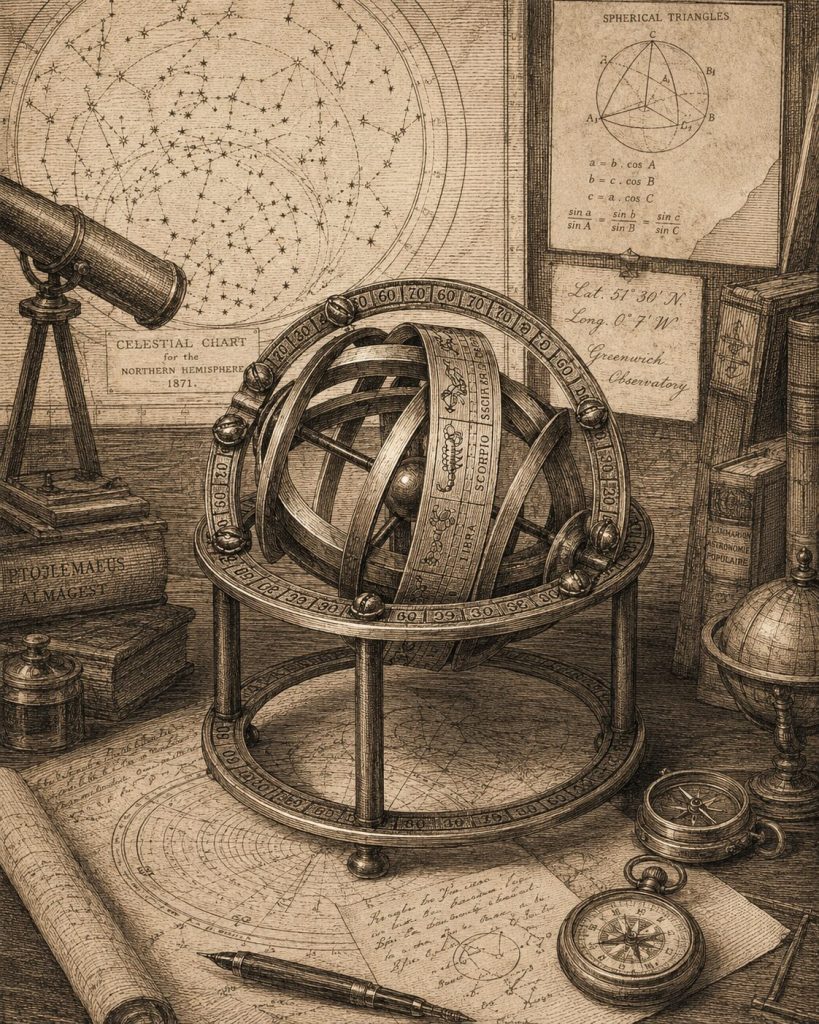
An armillary sphere is a model of the heavens.
Not a globe of the Earth.
Not a simple decorative orb.
Not just a pretty brass ring sculpture.
Its nested rings represent celestial circles: the celestial equator, the ecliptic, the tropics, the meridians, and other imagined lines that helped astronomers understand the sky as a structured system.
The form is ancient. Early armillary spheres are often associated with Greek astronomy, including figures such as Eratosthenes, who lived from roughly 276–194 BC. Over centuries, the object became one of the most recognizable symbols of astronomy: the sky translated into rings.
By the Renaissance, armillary spheres became larger, more elaborate, and more connected with scientific prestige. Tycho Brahe, one of the great observational astronomers, used large astronomical instruments – some monumental in size – to measure the heavens before the telescope became dominant.
This is why the object carries so much power in a modern Steampunk collection.
A gear says machine.
An armillary sphere says cosmos.
A gear asks how motion transfers.
An armillary sphere asks how the universe is arranged.
That is a larger question – and the room feels it.
Simplified armillary models also belong naturally to the world of navigation. Sailors, scholars, and instrument makers used celestial models to understand relationships between sky, latitude, season, and direction. Even when decorative, the form points toward navigation and astronomy rather than ordinary ornament.
The Victorian Scientific Instrument Tradition
By the 19th century, the armillary sphere had moved partly from functional astronomy into education and display.
That shift is important.
Victorian studies, libraries, and parlors often displayed objects that signaled intellectual seriousness: barometers, globes, telescopes, microscopes, thermometers, mantel clocks, maps, shells, specimens, and scientific models.
The object did not need to be used daily to matter.
It only needed to say: this household values knowledge.
That is exactly why the miniature brass armillary sphere works today. It continues the Victorian tradition of placing learned objects in domestic space. A tiny astronomical model on your desk says something different from a generic figurine. It suggests curiosity, navigation, measurement, and the old desire to make invisible systems visible.
That is deeply Steampunk.
The Steampunk engineer-explorer persona is not only a person with goggles and gears. It is someone who collects instruments, studies maps, tracks time, measures weather, reads the sky, and believes knowledge should have a physical form.
The Humaira Nautical Brass Armillary Sphere belongs to that lineage.
For the broader collecting tradition behind objects like this, see the Victorian collecting tradition – why objects like the armillary sphere mattered.
Material Assessment – Solid Brass Examined
Solid Brass vs. Brass-Plated – The Real Difference
The phrase solid brass is not decorative language.
It is a material claim.
Brass is an alloy of copper and zinc. When an object is solid brass, the metal is brass throughout. If the surface scratches, brass remains underneath. If it ages, it ages as brass. If it is polished, it can return to brightness. If left alone, it develops deeper color and patina.
Brass-plated objects are different. They have a thin brass layer over a cheaper base material – sometimes steel, zinc alloy, resin, or another substrate. Once the plating wears through, the illusion is gone.
That difference matters in a Steampunk collection, because the aesthetic is built on material truth.
The Humaira Armillary Sphere is valuable because it is presented as solid brass. That makes it materially stronger than plated decorative pieces. It should feel denser than plastic or resin, and it should have a clearer ring when lightly tapped.
There are simple tests buyers use for brass objects:
A magnet test can reveal brass-plated steel, because true brass does not attract a magnet.
A tap test can reveal density: solid metal rings more clearly than resin or plated hollow pieces.
Weight relative to size also matters: solid brass feels heavier than it looks.
None of these tests should be used aggressively. This is still a small decorative object. But they help explain why solid brass is not merely a marketing phrase.
It changes the object’s relationship with time.
Check Humaira Armillary Sphere quality
Patina Development Over Time
The best reason to own solid brass is that it can age honestly.
Over time, exposed brass darkens. It shifts from bright gold to honey, amber, brown, and sometimes deeper shadow tones in recesses. This process is not failure. It is the brass becoming more interesting.
For Steampunk decor, that is an advantage.
A brand-new shiny brass piece can look too clean. A slightly aged brass object feels more integrated beside dark wood, leather books, iron pipe shelves, amber glass, and warm lighting.
The lacquered wooden base is a separate element. It gives the sphere height and stability, and it also prevents the brass object from feeling like a loose trinket. The base makes it feel placed, not dropped.
Care depends on your preference.
Let the patina develop if you want authenticity.
Use a gentle brass polish if you prefer a brighter instrument-like look.
Avoid harsh abrasion, especially around ring details and joints.
If the sphere has lacquered brass areas, do not polish aggressively. Clean with a soft cloth and treat it like a display instrument rather than kitchen hardware.
For care principles, see our brass cleaning and patina guide – applies directly to solid brass objects.
The Scale Reality – Setting Correct Expectations
9cm Is 3.5 Inches
The biggest buyer misunderstanding is scale.
The Humaira Armillary Sphere is about 9cm tall, which is roughly 3.5 inches.
That is small.
Not uselessly small.
Not disappointing if expected.
But small.
In product photos, objects often appear larger because of tight framing, telephoto compression, and lack of familiar scale references. A tiny object can fill the frame and feel substantial. Then it arrives in hand, and the buyer realizes it is closer to the size of a large orange or baseball than a statement desk sculpture.
This review needs to say that clearly:
The Humaira Armillary Sphere is not a standalone focal object for a large room.
It is a shelf or desk accent.
It rewards close viewing. It belongs in a grouping. It should sit near books, pens, clocks, compass, hourglass, or gear charms. It is the kind of object someone notices on second glance, then leans closer to inspect.
That is not weakness.
That is its role.
A small brass object can be more powerful than a large resin one if placed correctly.
View on Amazon – check dimensions before ordering – Humaira Nautical Brass Armillary Sphere
The “Smaller Than Expected” Pattern
Size complaints are common for this kind of object.
That does not always mean the product is bad. It often means the buyer imagined a different product.
If you expect a 20cm armillary sphere, this is the wrong purchase.
If you understand 9cm as the context, the value looks different. You are not buying scale. You are buying solid brass, historical form, and desk-level detail.
The purchase logic should be:
Do I need a dominant visual object?
Then choose something larger, like a rotary phone ornament or hourglass.
Do I need a credible collector’s detail?
Then the armillary sphere makes sense.
When photographing or displaying it, always include companion objects that establish scale: a pen, bookmark, matchbox, small book, or watch. This prevents the object from feeling visually deceptive and helps the whole composition feel intentional.

Display Excellence – Making the Most of Small Scale
Grouping Principle
Small objects work best when they are grouped with intention.
The Humaira Armillary Sphere should rarely stand alone in a large empty space. It needs a constellation of related objects around it.
A strong grouping could look like this:
Hourglass as the tallest object.
Armillary sphere as the medium-height intellectual object.
Gear charms scattered low as mechanical texture.
A leather notebook or stack of books as the grounding surface.
A small compass or magnifying glass to complete the navigator-scientist story.
That creates a clear height progression:
tall → medium → low.
It also creates a clear material palette:
gold → brass → bronze → wood → paper.
This is where the armillary sphere succeeds. It does not dominate the vignette. It dignifies it.
Without it, the display may feel like generic mechanical decor.
With it, the display gains astronomy, navigation, and scientific history.
For grouping principles, see vignette curation guide – the grouping principles that make small objects read as a collection.
Base Integration
The lacquered wooden base is not a minor detail.
It solves two problems.
First, it stabilizes the sphere. Without a base, a miniature brass ring object could feel fragile, unstable, or toy-like. The base gives it a proper footing.
Second, it adds visual weight.
A small brass object on its own may look too delicate. A small brass object elevated on dark lacquered wood feels more like a scientific model.
The warm brown base also coordinates naturally with dark walnut shelving, mahogany desks, leather-bound books, and aged paper. In a Steampunk nautical desk decor arrangement, that matters. The base helps the object belong to the furniture, not merely sit on top of it.
On a shelf, place the base slightly forward, not pushed against the back wall. Let the rings cast small shadows. Give the object enough light from the side so the brass lines remain readable.
This is not a piece to bury.
It is small enough to need air.
Who Should Buy?
The Humaira Nautical Brass Armillary Sphere is perfect for the collector who values material authenticity over size.
It is also a strong gift for an astronomy enthusiast, navigation lover, Steampunk collector, or anyone building a scientist’s desk, navigator’s shelf, or cabinet of curiosities.
It is especially good as a first solid brass object in a Steampunk collection. Once placed among resin, acrylic, and plated pieces, it raises the entire material standard of the vignette.
Look elsewhere if you need dominant visual presence.
The Hourglass gives more height and function.
The Rotary Phone gives more narrative scale.
The Gear Charms give more visual variety per dollar.
But if your goal is one small object with real material integrity and deep historical lineage, the armillary sphere is difficult to replace.
Final Score
| Criteria | Score | Notes |
| Material Authenticity | 5/5 | Only solid brass object in the group – irreplaceable credential |
| Historical Lineage | 5/5 | Roughly 2,000-year history of the form |
| Handcraft Quality | 4.5/5 | Hand-polished look, authentic patina potential |
| Scale for Price | 3.5/5 | 9cm is genuinely small |
| Review Confidence | 3/5 | Around 158 reviews – smaller sample |
| Overall | 4.2/5 | Most materially authentic object in the cluster |
See Humaira Brass Armillary Sphere on Amazon
The Humaira Nautical Brass Armillary Sphere is not the loudest object in the guide.
It does not time your work like the hourglass.
It does not scatter texture like the gear charms.
It does not store secrets like the trinket box.
It does not tell an obvious story like the rotary phone.
It does something quieter.
It gives the shelf intellectual gravity.
A tiny solid brass armillary sphere says the room is not only interested in machines. It is interested in measurement, sky, navigation, history, and the old human desire to hold the universe in the hand.
That is why it belongs.
For the full comparison, see see the full steampunk small decor ranking.


