
Some industrial pipe shelves stretch across the wall.
The BIXIRAO Industrial Wall Mounted Pipe Shelf Brackets climb it.
That is the difference.
Most shelf systems think horizontally: one board, two brackets, maybe a longer span if the wall allows it. BIXIRAO thinks vertically. At 44.29 inches high, it does not behave like a simple shelf bracket. It behaves like a narrow industrial display column – a wall-mounted frame for books, instruments, bottles, clocks, and objects that need height as much as surface area.
That makes it one of the most visually dramatic products in this Steampunk shelving cluster.
But drama always asks for a tradeoff.
BIXIRAO gives you height, adjustability, and display flexibility. It does not give you the same confirmed heavy-duty material confidence as HITOMEN. It does not include wood like OLDRAINBOW. It also carries a material controversy in customer reviews that should not be ignored.
So this review is not about pretending BIXIRAO is perfect.
It is about understanding what it actually is:
a multi-tier pipe shelf frame for buyers who care more about vertical display composition than pure structural muscle.
For the full shelf category, see where BIXIRAO fits among the Steampunk shelf systems built for serious collectors.

Want to check the full vertical frame before choosing boards? Check the BIXIRAO Industrial Wall Mounted Pipe Shelf Brackets on Amazon.
44 Inches of Vertical Industrial Statement
The first thing to understand about BIXIRAO is scale.
At 44.29 inches high, this is not a quiet bracket system. It has enough height to become part of the wall’s architecture. Once mounted, it reads less like a shelf accessory and more like a vertical rack pulled from an old workshop, laboratory, or mechanical archive.
That is its strength.
No other product in this guide works in the vertical dimension quite the same way. OLDRAINBOW gives you a complete horizontal shelf system. HITOMEN gives you heavy-duty pipe credibility. Janyang gives you DIY bracket freedom. Helsin gives you bathroom utility.
BIXIRAO gives you a column.
That makes it especially useful for Steampunk display, because Steampunk objects often vary wildly in height. A telescope needs clearance. A globe needs breathing room. A clock wants visual command. Specimen jars, books, bottles, and brass tools need smaller, denser zones.
A normal fixed shelf forces the collection to obey the shelf.
BIXIRAO lets the shelf obey the collection – at least before final assembly.
That is the real appeal of the adjustable tier system.
But buyers should frame it honestly. BIXIRAO is not the heavy-duty workhorse in this cluster. That role belongs to HITOMEN. BIXIRAO is the showpiece: vertical, adjustable, visually theatrical, and best when the display itself is the point.
The Adjustable Tier System – How It Works
The word “adjustable” can sound more flexible than it really is.
With BIXIRAO, adjustability is valuable, but it belongs mostly to the planning stage.
What “Adjustable” Actually Means
With BIXIRAO, adjustable tier spacing refers to the ability to set the shelf levels within the pipe-frame structure. You can plan where each shelf level sits before the unit is fully assembled and mounted.
That is useful.
But it is not the same as effortless daily adjustability.
Once the frame is assembled, mounted, loaded with boards, and styled, changing tier positions becomes more involved. You may need to dismount, loosen, reposition, re-level, and reassemble.
So the smart approach is to treat adjustability as a planning-stage advantage, not a casual afterthought.
Before installation, lay out the objects you intend to display.
A tall brass telescope? A medium mantel clock? A stack of old books? A row of amber glass bottles? A small specimen jar cluster?
Those object heights should decide the tier spacing.
Not symmetry for symmetry’s sake.
A display shelf should serve the display.
Planning Display Before Installing
The BIXIRAO frame becomes strongest when you assign each tier a purpose.
For tall statement objects like a globe, telescope, large clock, or framed scientific drawing, plan for around 18 inches of vertical clearance.
For medium objects like books, smaller clocks, barometers, boxes, or framed prints, around 12 inches usually feels comfortable.
For small objects like vials, figurines, pocket watches, short bottles, and gear clusters, 8-10 inches can work.
The important part is variation.
A Steampunk shelf with every tier spaced evenly can look rigid. A shelf with one generous opening, two medium zones, and one tighter detail shelf feels more curated. It creates hierarchy.
That is where BIXIRAO becomes interesting.
You can make room for a tall instrument on one level, books on another, and small artifacts below. That kind of tier logic is difficult with fixed systems.
For planning display heights before locking in the frame, read the shelf-styling guide that helps your objects decide the tier spacing.
Multiple Tier Options
BIXIRAO is available in different tier configurations, including 3-tier, 4-tier, and 5-tier options.
The 4-tier version is the balanced choice.
A 3-tier version has less visual weight and is easier to live with in smaller rooms. It gives the wall some industrial structure without turning it into a full vertical rack.
A 5-tier version maximizes density, but it also demands more wall height and more visual discipline. Too many tiers, poorly styled, can begin to feel crowded rather than curated.
This is the same issue that appears with any tall industrial shelf: more storage does not automatically mean better display.
In small rooms, the frame can feel heavy. A vertical system close to four feet tall changes the room’s visual gravity.
That is not a defect.
It is the product doing what it was built to do.
Just make sure the room can handle it.

The Material Controversy – Addressed Directly
This is the section that keeps the review honest.
BIXIRAO looks convincing, but not every buyer agrees on the material claim.
The Customer Review Problem
BIXIRAO has one issue that needs to be said plainly:
not every buyer agrees with the material authenticity.
One customer review states that the product is not true industrial iron pipe, but a cheaper alloy painted to resemble industrial black iron.
That kind of review cannot be ignored.
A serious Steampunk buyer cares about material authenticity. The difference between real iron pipe and a lighter alloy is not only technical. It changes sound, weight, surface feel, aging behavior, and emotional credibility.
A pipe that feels dense in the hand carries authority.
A pipe that sounds hollow or light when tapped may still function, but it does not tell the same story.
At the same time, the full review pattern appears mixed rather than disastrous. Other buyers describe the product as strong, sturdy, and suitable for shelf use.
So the most reasonable interpretation is this:
BIXIRAO likely delivers a convincing industrial pipe look, but buyers should not assume it has the same material certainty as a clearly specified 1-inch iron pipe system like HITOMEN.
For understanding the difference between visual pipe style and true exposed bracket honesty, read the guide that teaches you what honest industrial hardware should look and feel like.
What This Means for Buyers
The material controversy has two effects.
The first is structural.
If the shelf performs well under normal display loads, the exact metal composition may not matter to every buyer. Many alloy or composite-style metal products can be completely adequate for books, objects, and decor when installed correctly.
The second is aesthetic.
This is where purists will care more.
A true iron pipe has weight, density, and a certain cold confidence. It sounds different when tapped. It ages differently at scratches and edges. It takes patina differently. It simply feels more industrial.
From 1.5 meters away, a well-finished pipe-look frame may be visually indistinguishable from true iron pipe. On the wall, surrounded by books, wood, glass, brass, and shadow, the difference may not matter.
In the hand, it might.
So the verdict is not “avoid.”
The verdict is: buy BIXIRAO for vertical display and adjustable tier spacing, not for confirmed pure iron authenticity.
If confirmed heavy-duty pipe is your priority, look at HITOMEN instead.
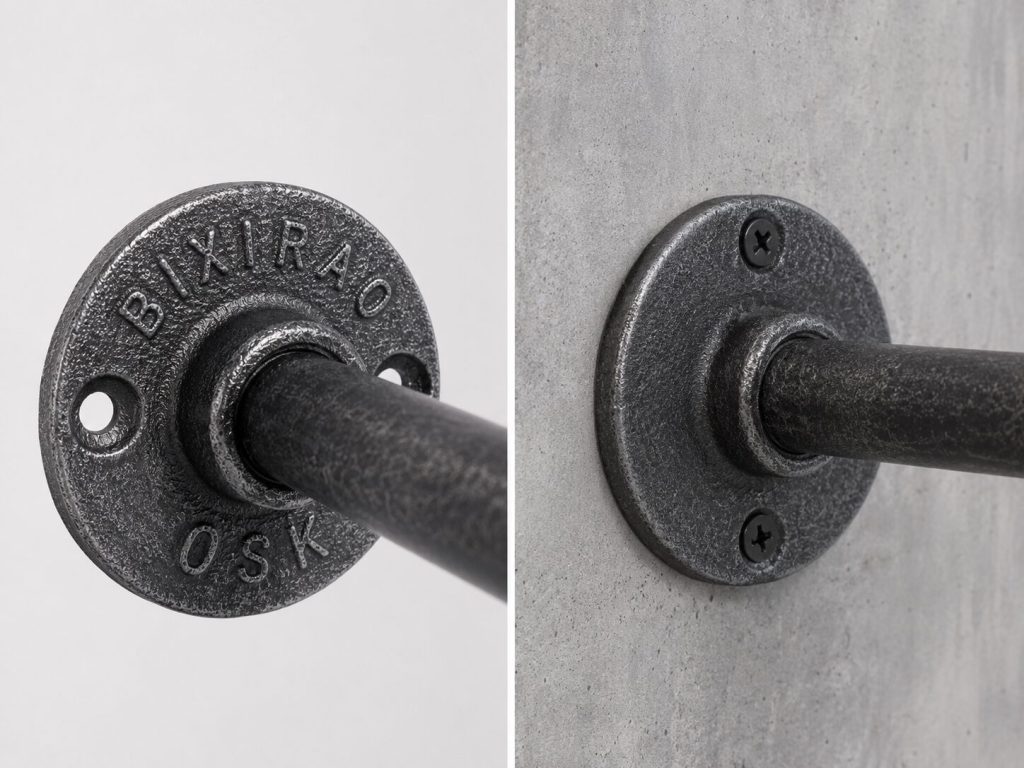
The Stamped Letters Issue
Another customer note mentions large stamped letters on the wall mount plates.
This kind of detail can bother buyers who want a clean industrial surface. If the lettering is visible after installation, it may interrupt the illusion of old pipe hardware.
But placement matters.
Depending on orientation, those letters may face the wall and disappear entirely. If visible, they can be filled with a matte black paint pen, darkened with finish, or reframed as part of the “factory stamp” aesthetic.
A real industrial object often carries markings: numbers, letters, foundry marks, cast codes, manufacturer stamps.
The question is whether the marking feels accidental or authentic.
If it faces the wall, the wall does not mind.
Installation Notes
BIXIRAO is not a lightweight decorative ledge.
It is a tall vertical frame, and that changes the installation logic.
The Weight Reality
One customer described the unit as too heavy.
For BIXIRAO, that comment is less a defect than a warning.
A 44-inch industrial shelf frame should not be treated like a lightweight decorative wall accent. It needs a solid wall, careful mounting, and enough screws or anchors to distribute the load.
Drywall-only installation is not ideal for a tall frame loaded with wood and objects. Stud mounting is the safer baseline. If studs do not align with the frame, use proper anchors and keep the load conservative.
This is not the place for casual installation.
The shelf’s height creates leverage. The load is distributed vertically. The frame has to remain aligned under both shelf weight and object weight.
Also important: do not use a pipe wrench aggressively during assembly.
Hand-tightening is usually safer for pipe-style shelf systems, especially if the finish can scratch or if the threads are not heavy industrial-grade. Over-tightening can damage threads, mark the surface, or create alignment problems.
As with all pipe shelving:
tight enough to be stable, not so tight that you punish the hardware.
The Vertical Space Consumption
BIXIRAO takes wall space seriously.
At 44.29 inches, it occupies roughly 3.7 feet of vertical territory. That is enough to change the room’s visual structure.
In rooms with taller ceilings, this can be excellent. The shelf fills dead wall height, gives the room a stronger vertical axis, and creates a display zone that feels architectural.
In rooms with low ceilings or limited wall space, it can become heavy.
This is why BIXIRAO works best in studies, living rooms, feature walls, reading corners, tall narrow walls, corners, workshop-inspired rooms, and spaces with 2.7m+ ceilings or enough vertical clearance.
It is less ideal in small rooms under about 12m², narrow hallways, or walls already crowded with art, sconces, and shelving.
BIXIRAO wants to be seen.
Do not install it where the room needs silence.
Wood Selection for BIXIRAO – The 1.18-Inch Recommendation
BIXIRAO does not include wood, so board choice becomes part of the product experience.
The recommended board thickness is around 1.18 inches, or 30mm, with a maximum width around 12 inches.
That recommendation is not random.
A tall pipe frame paired with thin boards looks visually wrong. The structure rises with industrial confidence, but the shelf surface looks weak. The wall begins to feel unbalanced: heavy vertical metal, timid horizontal planks.
A 1.18-inch board gives the shelves enough thickness to visually answer the frame.
Good wood choices include dark walnut, reclaimed oak, and stained pine at 1.18 inches.
Dark walnut is the premium Steampunk option: warm, deep, refined, and excellent for studies or collector walls.
Reclaimed oak is the most authentic industrial option: strong grain, visible history, and enough density to match the frame.
Stained pine is the practical option: more affordable, easier to source, and convincing if stained dark and sealed properly.
Avoid thin pale boards unless the entire room is intentionally light industrial. With BIXIRAO, the frame is tall enough that weak boards become obvious.
For the full board guide, read the wood-selection guide that explains why tall pipe frames need thicker boards.
BIXIRAO’s Correct Use Case
BIXIRAO is not a universal shelf solution.
It is excellent in the right place and awkward in the wrong one.
Ideal Scenarios
Feature wall in a study or living room
The 44-inch vertical presence draws the eye immediately. This makes it useful as a visual anchor, especially if the surrounding wall is quiet.
Corner installation
A vertical frame can occupy a corner without using floor space. This works beautifully in Steampunk rooms because corners naturally suit whatnot-style display columns.
Progressive display
Use tier spacing to tell a vertical story. Tall scientific instrument at the top. Books and clocks in the middle. Dense small objects at the bottom.
This creates hierarchy instead of clutter.
Not Ideal
Small rooms
The frame can dominate. If the wall is too small, the shelf may feel like machinery installed in a closet.
Heavy-load collections
If your goal is dense books, cast iron objects, and confirmed structural strength, HITOMEN is the safer choice.
Budget-first buyers
BIXIRAO makes sense when you value adjustability and vertical drama. If you only need brackets to hold a board, Janyang may be more practical.
For the heavy-duty alternative, read the HITOMEN review for buyers who trust 1-inch iron pipe more than adjustable drama.
If what you want is a tall, adjustable display frame rather than a heavy-duty pipe workhorse, see the BIXIRAO Industrial Pipe Shelf Brackets on Amazon.
Final Score
| Criteria | Score | Note |
| Pipe Authenticity | 3/5 | Material controversy exists; alloy or composite metal may not satisfy purists |
| Adjustability | 5/5 | Only product in the group built around adjustable tier spacing |
| Visual Drama | 5/5 | 44-inch vertical presence is unmatched |
| Load Rating | 3.5/5 | Not clearly specified; structural feedback is positive but material questions remain |
| Installation | 3/5 | Heavy, requires solid wall, and stamped-letter concern may bother some buyers |
| Overall | 3.9/5 | Best for vertical display drama; buy knowing the tradeoffs |
BIXIRAO is the shelf frame for the collector who thinks vertically.
It is not the most materially certain option. It is not the best confirmed heavy-load system. It does not include wood, and it demands planning before installation.
But it gives something the others do not:
a tall, adjustable, industrial display column.
That matters if your wall needs more than a plank. It matters if your collection includes objects of different heights. It matters if you want a Steampunk shelf that behaves like a modern descendant of the Victorian whatnot – tiered, vertical, intentional, and a little theatrical.
Buy BIXIRAO for display logic.
Buy HITOMEN for heavy-duty confidence.
Buy OLDRAINBOW for complete convenience.
But if the wall needs height, rhythm, and a frame that lets the collection rise rather than spread, BIXIRAO earns its place.For category comparison, compare BIXIRAO against the full Steampunk industrial shelf lineup before choosing your wall system.


